
Before philosophy, theology, or science attempted to explain consciousness, humans encountered it directly through experience. Long before abstract theories of mind or metaphysical hierarchies were formalized, early societies developed practical maps for navigating altered states, illness, death, and the forces they perceived as shaping reality. Shamanic cosmologies represent the earliest known attempt to organize those encounters into a coherent structure.
This entry examines shamanic cosmologies not as belief systems, but as early models of consciousness—embodied, ecological, and experiential. These frameworks emerged from direct engagement with trance, vision, and ritual, forming layered maps of reality that allowed human awareness to move between states while maintaining communal stability. In the context of this consciousness series, shamanism functions as the root layer: the original grammar from which later metaphysical, psychological, and spiritual systems evolved.
What follows traces how these early models formed, how they operated, and why their structure continues to appear—refined but recognizable—across cultures, disciplines, and modern frameworks of consciousness.
꩜ Origins & Historical Roots
Shamanic cosmologies stretch back tens of thousands of years into the Paleolithic, when the line between human survival and spiritual vision was razor-thin. The shaman was not a priest in a temple but a hunter, healer, and dreamer on the edge of the tribe. Through trance, vision, and ordeal, they forged the first maps of reality—maps that revealed a cosmos layered, alive, and threaded with spirit. These were not abstract doctrines; they were survival tools. To heal the sick, find the game, or bury the dead, early humans needed a framework that made sense of the forces beyond their control. What they discovered, or constructed, was a world with multiple layers, traversable in altered states, inhabited by beings both benevolent and dangerous.
The earliest evidence of these cosmologies can be found in cave art. In sites like Lascaux and Chauvet in France (ca. 30,000–17,000 BCE), animals are painted not as food but as presences—towering, luminous, often depicted in movement or half-hidden in niches of the cave. Scholars have long argued these caves were sanctuaries for ritual and trance. The caves themselves functioned as a symbolic underworld: entering the earth’s belly, descending into darkness, encountering visions by torchlight. Dots, spirals, and lattice shapes etched beside the animals resemble patterns seen in entoptic visions during altered states—geometries produced by the nervous system under stress, drumming, or entheogens. These marks suggest that the cave walls were not canvases but thresholds: places where human and spirit worlds met.
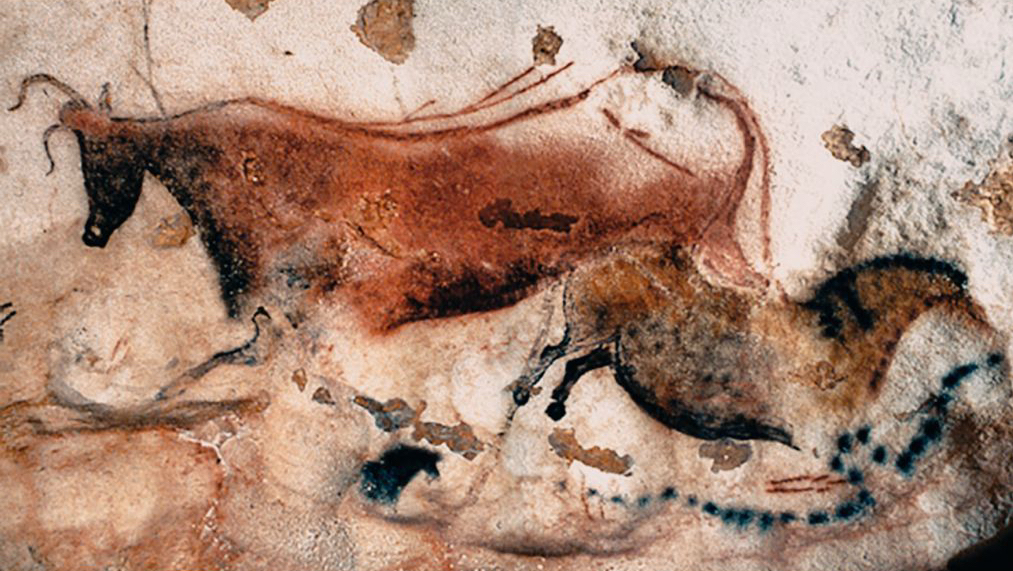
Wall painting from Lascaux Cave, Dordogne, France — Paleolithic herd and abstract motifs in ochre and charcoal (ca. 17,000 BCE). Public domain / Bradshaw Foundation archive
Archaeology provides further clues: the discovery of ritual burials with grave goods (as early as 100,000 BCE) shows belief in a world beyond death. Red ochre sprinkled on bones mimicked the color of blood and renewal, signaling a cosmology where the soul traveled beyond the body. Shamans, as mediators, were tasked with guiding that journey. Tools such as rattles, drums, and psychoactive plants (from Siberian amanita muscaria mushrooms to Amazonian ayahuasca brews) gave them access to trance states. In those altered states, the cosmos revealed itself as multi-tiered: upper realms of sky and divinity, lower realms of ancestors and spirits, and a middle realm of ordinary life. This tripartite cosmos—upper, middle, lower—became the archetype repeated in cultures worldwide.

Cueva del Castillo (El Castillo Cave), Cantabria, Spain — red ochre hand stencils and dot motifs, ca. 40 000 BCE.
Public Domain — image courtesy of the Spanish Cultural Heritage archives / Wikimedia Commons.
Across Siberia, where the very word “shaman” (šaman in Tungusic languages) originates, this layered world was explicit. The shaman climbed a pole or tree in ritual, reenacting the ascent through the worlds. The drum itself was said to be a horse or reindeer that carried the soul across realms. Among the Evenki and Yakut, the upper world housed sky gods and celestial beings, the lower world was home to ancestral shades and underworld lords, and the middle world was the terrain of humans and nature spirits. The shaman’s role was to mediate among them, restoring balance when illness, drought, or misfortune disrupted the flow.
Similar structures appear in the Americas. Among the Lakota, vision quests on sacred mountains mirrored ascent to the upper world, while sweat lodges symbolized descent into the womb of the earth. The Amazonian ayahuasca traditions describe layered jungles and rivers leading into spirit realms, where plant-beings and animal allies teach and heal. The Maya spoke of Xibalba, the underworld accessed through caves and cenotes, where heroes descended to battle lords of death. Each of these is unique, but the common thread is unmistakable: reality is not flat, but tiered; the human soul can travel between tiers; and balance must be maintained through ritual exchange.
The origins of shamanic cosmologies, then, are not in doctrine but in experience. The human nervous system itself provided the imagery: spirals, tunnels, lights, beings encountered in the borderlands of consciousness. Communities shaped these visions into shared cosmologies, tested in ritual, passed on as myth. Over time, the structure stabilized: an upper world of gods and celestial beings, a lower world of ancestors and spirits of the dead, a middle world of everyday life. The axis mundi—world tree, sacred mountain, cosmic river—connected them, giving the shaman a pathway.
What makes shamanic cosmologies the rootsystem of later mysticism is that they predate and underlie every later metaphysical ladder. Theosophy’s planes, Kabbalah’s Four Worlds, Integral’s stages, Hawkins’ calibrations—all are refinements of the primal intuition first forged in caves and rituals: that existence is layered, that consciousness can travel, and that survival depends on maintaining balance between realms. The shaman’s world is raw, ecological, bodily. Later systems would refine it into philosophy, theology, and abstraction. But the bones of the map—the threefold cosmos, the ladder of ascent, the spirits as mediators—were laid down here, at humanity’s beginning.
━━━━━━━━━━━━━━━ ✦ ━━━━━━━━━━━━━━━
꩜ Core Structure of the Cosmos
Each tier is distinct yet permeable, and the shaman’s task is to traverse them.
The Middle World — the everyday plane
The Middle World is where humans dwell, the realm of ordinary life: hunting, farming, weather, childbirth, death. But it is not just “physical reality.” In shamanic thought, the Middle World is saturated with spirits—animals, plants, rivers, winds, mountains. Nothing is inert. Every stone, tree, and stream has presence. Shamans treat this world as the zone of constant negotiation: humans must honor the other beings they share it with. Illness, misfortune, or ecological collapse occur when that balance is violated—when hunting exceeds respect, when ritual obligations are ignored. Unlike later mystical systems that disparage the “mundane” as lesser, the Middle World is central, the field where survival and spirit weave together.
The Upper World — the realm of sky and divinity
The Upper World is accessed by ascent: climbing a tree, pole, or mountain in ritual; in trance, flying upward through tunnels of light, stars, or clouds. It is the domain of sky gods, celestial beings, ancestral spirits elevated to higher stations, and often bird-guides who carry the shaman upward. Cultures describe it as luminous, ordered, and hierarchical: multiple heavens stacked above one another, with the highest occupied by the most radiant powers. Here, the shaman seeks guidance, prophecy, and blessing. Encounters in the Upper World grant visions of destiny, messages for the tribe, and renewal of cosmic order. Unlike the Middle World’s intimacy with daily life, the Upper World is oriented toward transcendence and authority.
The Lower World — the realm of earth and ancestors
The Lower World is entered by descent: through caves, rivers, holes in the ground, or symbolic burials in ritual. Despite modern stereotypes of “underworld = hell,” shamanic Lower Worlds are not inherently evil. They are the domains of ancestors, chthonic deities, and animal powers. Here dwell guides in the form of jaguars, serpents, wolves, or bears—spirits that lend strength, healing, and protection. It is also the place where lost souls wander, where sickness originates when balance is broken, and where the shaman may battle hostile beings. In many traditions, the Lower World is the womb as well as the grave: the source of fertility, renewal, and power. It is terrifying, but it is also vital. Shamans return from it carrying both danger and medicine.
The Axis Mundi — the cosmic connector
Threading these three realms is the axis mundi, the world’s central column. Its forms vary: the Siberian birch tree, the Norse Yggdrasil, the Mayan ceiba tree, the Native American sacred mountain, the Amazonian river, even the human spine in trance.
The axis is both symbolic and experiential: in trance, shamans climb or descend it to move between worlds. Ritual poles erected in ceremonies become temporary axis points, turning a village into the center of the cosmos. The axis mundi ensures the worlds are not isolated spheres but a continuous whole—permeable, connected, alive.
Spirits as inhabitants of the worlds
Each world is populated by spirits appropriate to its nature.
In the Middle World: animal guardians, plant teachers, elemental presences.
In the Upper World: shining ancestors, bird-guides, celestial gods.
In the Lower World: chthonic beings, ancestors of deep time, animal predators who lend their ferocity.
These spirits are not abstractions—they are relational. Shamans interact with them as allies or adversaries, forging bonds of reciprocity. The structure is not empty geography; it is inhabited ecology, a cosmos alive with voices.
It is not a hierarchy in the sense of “better versus worse,” but a cycle of balance. The Middle World depends on the Upper for guidance and order, on the Lower for fertility and power, and both depend on the Middle for ritual reciprocity. Shamanic cosmology, at its core, is a layered ecology of spirit, where survival depends on honoring the whole.
━━━━━━━━━━━━━━━ ✦ ━━━━━━━━━━━━━━━
꩜ Functional Role of the Model
Shamanic cosmologies were never abstract speculation. They emerged as working systems—frameworks that explained illness and death, structured ritual and healing, and held the tribe in balance with the forces of nature. Their function was pragmatic as much as spiritual: they gave meaning where chaos threatened, and tools where survival demanded.
Explaining illness and misfortune
In a world without modern medicine or science, illness, drought, and disaster could feel random and devastating. The layered cosmos provided an explanation: misfortune signaled a break in the web between worlds. Perhaps a soul had wandered into the Lower World, or an angry ancestor withheld blessing, or a neglected offering offended a local spirit. By locating the cause in the cosmos, shamans could act. They might retrieve the lost soul, negotiate with the offended being, or restore balance with offerings. Illness was not meaningless—it was a disruption that could be diagnosed and repaired.
Healing as cosmic rebalancing
The shaman’s central function was to heal, not only bodies but relationships between worlds. A cure might involve drumming, chanting, or ritual flight into the Lower World to retrieve a fragment of the patient’s soul—a practice known as soul retrieval. Or it might involve ascending to the Upper World to call down guidance or blessing. Healing was not chemical but relational: health meant being woven correctly into the cosmic fabric. The patient’s recovery reaffirmed the tribe’s belief that balance could be restored.
Divination and decision-making
The layered cosmos also functioned as a source of knowledge. When hunting parties needed to know where game would be found, or when the tribe faced famine or migration, the shaman entered trance to consult the spirits. The Upper World offered prophecy, the Lower World revealed hidden causes, the Middle World’s animal allies gave signs. The cosmos was a living oracle, and the shaman its interpreter. In this way, cosmology shaped concrete decisions: where to hunt, when to plant, when to move.
Mediating life and death
Another function was to guide souls. In many traditions, death was not an end but a passage into the Lower World, where ancestors dwelled. But the transition was perilous: souls could wander, be trapped, or become malevolent if not properly escorted. Shamans acted as psychopomps, leading the dead to their rightful place, ensuring the tribe remained at peace with the ancestors. Funerary rituals often reenacted this journey—chants, drumming, or symbolic paths guiding the soul downward. In this way, the layered cosmos integrated death into the rhythm of life, making loss bearable through structure.
Maintaining ecological balance
Perhaps most importantly, shamanic cosmologies kept humans bound to the larger web of life. The Middle World was not theirs alone; it belonged equally to animals, plants, rivers, and winds. Ritual offerings—tobacco scattered, animals honored after the hunt, dances performed at seasonal shifts—were forms of reciprocity, payments that kept the cosmos in balance. The model taught that overhunting, disrespect, or neglect would anger spirits, leading to illness or famine. In this way, cosmology functioned as ecological ethics, ensuring survival by weaving reverence into every act.
Taken together, the functional role of the three-tiered cosmos was comprehensive: it explained suffering, structured healing, guided choices, integrated death, and grounded humans in ecological reciprocity. It was not a luxury—it was the operating system of early societies. Without it, the world was chaotic and dangerous. With it, the world was intelligible, relational, and survivable.
━━━━━━━━━━━━━━━ ✦ ━━━━━━━━━━━━━━━
꩜ Human Interaction with the Cosmos
The layered cosmos of shamanic tradition was not a passive backdrop but a living environment constantly engaged by human action. Every trance, every rite, every offering was a negotiation with its powers. Interaction with this cosmos unfolded on multiple levels—physiological, psychological, social, and spiritual—and each level reinforced the others.
The physiology of altered states
Shamans did not theorize about “brainwaves,” but their methods show an intuitive mastery of the nervous system. Steady drumming at 4–7 beats per second corresponds to theta brain rhythms, the same frequency associated with hypnagogic imagery and dream states. Prolonged chanting manipulates breathing, altering blood CO₂ levels and pushing the body into trance. Psychoactive plants like amanita mushrooms or ayahuasca introduced neurochemical jolts, amplifying visions. Fasting, sleep deprivation, and physical ordeals added stress that broke down the ordinary sense of self. These physiological techniques reliably opened the threshold, allowing the shaman to “exit” the Middle World and enter the imaginal terrain of Upper or Lower realms. To the shaman, this was not neurology but soul flight—yet the mechanics reveal a sophisticated embodied technology.
The psychology of the journey
In trance, the shaman encountered vivid imagery: tunnels, spirals, animals, ancestors. Modern psychology recognizes many of these as entoptic phenomena—geometries generated by the visual cortex under altered conditions. But for shamans, these were not random—they were doorways. The spiral was the path upward, the tunnel the descent, the animal a spirit-guide. The human mind provided the raw imagery, and culture gave it meaning. Over generations, societies stabilized these visions into shared cosmologies. Thus, when a shaman reported flying with birds or diving into rivers of fire, the community recognized the terrain. Individual experiences became collective maps.
The social contract of shamanism
Human interaction with the cosmos was never solitary—it was sanctioned and witnessed by the tribe. A shaman’s journey only mattered if it returned with results: the patient healed, the hunt successful, the storm diverted. Communities held shamans accountable. The cosmology functioned as a social contract: shamans ventured into danger so the tribe could survive. In return, the tribe honored them with status, gifts, or authority. The layered cosmos, then, was not simply a private inner world but a public system where visions had practical consequences.
Ritual as collective participation
Interaction with the cosmos was distributed across the community. Initiation rites placed novices into isolation, fasting, or wilderness journeys, forcing them into contact with spirits. Seasonal festivals dramatized cosmic balance—reenacting death and rebirth, descent and ascent, often with masks and costumes that embodied spirits. Funerary rites guided the dead into the Lower World, ensuring the ancestors remained allies rather than threats. Through these rituals, the community rehearsed the structure of the cosmos. They did not need to enter trance themselves—the myth enacted before their eyes reminded them of the worlds they lived within.
The relational economy of spirits
Interaction with the cosmos was not mechanical but relational. Shamans treated spirits as beings with agency: animals, plants, and ancestors were approached as partners in negotiation. A hunter who killed without ritual apology risked spiritual retaliation. A farmer who ignored offerings to land-spirits risked crop failure. Shamans cultivated alliances—bear spirits for ferocity, serpents for transformation, birds for ascent. The economy was reciprocal: gifts of tobacco, blood, song, or food in exchange for guidance, power, and healing. This relational dynamic reveals shamanic cosmology as ecology before ecology: survival was achieved not by conquest of nature but by honoring its spirits.
Myth as cosmological memory
Interaction also occurred through story. Myths preserved the journeys of past shamans, codifying the geography of the worlds. Children learned early about the Upper Sky Father, the Lower Serpent Mother, the Tree of Life that connected them. These stories were not entertainment—they were maps. By listening, the tribe rehearsed cosmology mentally, ensuring that when crisis struck, the shaman’s journey would unfold within a familiar framework. Myths were mnemonic devices for a cosmos too vast to hold in memory alone.
In sum, human interaction with the shamanic cosmos was multi-layered. Physiological techniques opened the threshold; psychological imagery populated it; cultural frameworks stabilized it; social contracts enforced it; rituals dramatized it; myths remembered it. The cosmos was not a doctrine but a lived field of relationship, constantly renewed by practice. For early societies, this was how reality itself functioned: a layered environment where humans, animals, ancestors, and gods interacted daily.
━━━━━━━━━━━━━━━ ✦ ━━━━━━━━━━━━━━━
꩜ Purpose & Function
At their core, shamanic cosmologies were not ornamental myths or primitive guesses about the universe. They were operative systems—designed to keep human life in balance with forces far larger than the tribe itself. Their esoteric function was to bind together the visible and invisible, the human and the more-than-human, into a single coherent field of meaning and survival.
1. Mediating between worlds
The central purpose of the shaman was to stand in the gap. The tribe could not safely enter the Upper or Lower Worlds, but it depended on them for health, fertility, and continuity. The shaman’s journeys made those exchanges possible. They negotiated with ancestors, bargained with animal spirits, sought favor from sky beings, and returned with guidance or healing. The esoteric function here was mediation: ensuring the flow of power and blessing between realms without overwhelming the fragile human community.
2. Restoring balance when it was broken
Life was precarious—illness, famine, storms, or death could rupture the community’s equilibrium. Shamanic cosmology provided a mechanism for repair. If illness was caused by soul-loss, the shaman descended into the Lower World to retrieve it. If hunting failed, offerings and rituals renewed the covenant with animal spirits. If death threatened to linger, the shaman escorted the soul to its resting place. The purpose was not to explain away misfortune but to act decisively against it. Balance was never static; it was constantly maintained by ritual engagement with the cosmos.
3. Protecting the tribe from spiritual chaos
The layered structure of worlds served as a safeguard. Without it, the raw forces of death, fertility, or transcendence could overwhelm human life. By placing these forces in distinct realms, with pathways and guardians, shamanic cosmology contained chaos within order. Dangerous powers were acknowledged but given proper boundaries: spirits of the dead in the Lower World, celestial beings in the Upper, humans in the Middle. The esoteric function here was containment—structuring reality so that contact with overwhelming forces became survivable.
4. Encoding ecological reciprocity
One of the deepest functions of shamanic cosmology was to weave ethics into cosmology. By animating the Middle World with spirits—of animals, rivers, and forests—it ensured humans treated nature as a partner, not an object. Ritual apologies to a slain animal, offerings to the land before planting, taboos against excess hunting—all reinforced reciprocity. The cosmos itself demanded restraint and reverence. The esoteric purpose here was ecological: embedding sustainability in ritual so that survival was not just physical but relational.
5. Linking humans to cosmic cycles
Shamanic cosmologies also gave meaning to the great rhythms: birth, puberty, marriage, death, seasons, migrations. Each transition was ritually tied to the structure of the cosmos. Initiates were symbolically buried (descent to the Lower World) and then reborn (ascent to the Middle). Fertility rites mirrored the union of sky and earth. Death rites aligned the departed with ancestors below or stars above. In this way, human life was threaded into cosmic cycles, preventing alienation. The esoteric function here was integration: no stage of life stood outside the cosmic order.
6. Preserving collective memory
Finally, the layered cosmos served as a living archive. Myths, rituals, and visions encoded ancestral knowledge about plants, animals, survival strategies, and social norms. By framing this knowledge within cosmology, it became sacred and memorable. The story of a trickster coyote stealing fire preserved fire-making lore. The myth of a serpent guarding water holes encoded rules of water use. In this way, cosmology functioned as data storage, preserving wisdom across generations.
Taken together, the purpose and esoteric function of shamanic cosmologies was nothing less than to hold the world together. They mediated power, restored balance, contained chaos, enforced reciprocity, integrated life stages, and preserved memory. Their value lay not in speculation but in operation: they were technologies of survival, as essential to the tribe as hunting or fire.
━━━━━━━━━━━━━━━ ✦ ━━━━━━━━━━━━━━━
꩜ Limits
Shamanic cosmologies, while powerful and enduring, has its limits. They carry limitations that emerge from within their own diversity, from how modern observers interpret them, and from how they’ve been appropriated into new contexts. To understand their value fully, we must also face their fault lines.
1. The problem of the term “shamanism”
The very word shaman comes from the Tungusic languages of Siberia (šaman = “one who knows”), yet it has been stretched by anthropologists to cover radically different practices across the globe. A Siberian Evenki ecstatic, an Amazonian ayahuasquero, and a Lakota vision-quester all inhabit layered cosmologies, but their rituals, beliefs, and techniques differ profoundly. Using one umbrella term risks erasing diversity, collapsing hundreds of distinct traditions into a single generic model. The criticism here is that “shamanism” can be a colonial category—a simplification imposed from outside.
2. Romanticization and projection
Modern seekers often idealize shamanic cosmologies as “pure,” “primitive,” or “in harmony with nature,” projecting onto them a lost Eden. This romantic lens flattens complexity: shamans were not always benevolent; they could be feared, accused of sorcery, or blamed for misfortune. The spirit world itself was not uniformly nurturing—it was dangerous, unpredictable, often hostile. By sanitizing shamanism into a pastoral fantasy, we miss the edge: the blood, fear, and risk that defined it. The criticism here is one of oversimplification: making shamanism safe and palatable for modern consumption.
3. Limits of universality
While the three-world structure (Upper, Middle, Lower) appears nearly universal, there are exceptions. Some traditions describe four, five, or even nine layered realms. The Norse Yggdrasil holds nine worlds; Mesoamerican cosmologies speak of thirteen heavens and nine underworlds. Reducing everything to the three-world model risks ignoring this diversity. The criticism is that the so-called “universal structure” may be more an artifact of anthropological generalization than an absolute truth.
4. Colonial distortion and suppression
Colonialism disrupted and distorted many indigenous cosmologies. Missionaries branded shamans as sorcerers or devil-worshippers, suppressing rituals and demonizing spirits. Anthropologists often recorded practices through Christian or scientific lenses, mistranslating or misunderstanding their meaning. Even when revived in modern neo-shamanism, these cosmologies often return in fragments, divorced from the full lifeworld of the cultures that birthed them. The limit here is cultural rupture: what survives is often partial or filtered.
5. Appropriation in modern spirituality
In New Age and neo-shamanic circles, shamanic cosmologies are frequently simplified into guided meditations, weekend workshops, or commodified rituals. While this makes them accessible, it risks stripping them of depth and context. A Siberian ritual involving fasting, drumming, and communal sacrifice may be reduced to a “journey to meet your power animal” in a two-hour session. Critics argue this turns sacred traditions into consumer products, hollowing out their original purpose. The danger here is trivialization: cosmology reduced to technique.
6. Limits of verification
From a modern scientific perspective, shamanic cosmologies cannot be empirically verified. The Upper and Lower Worlds are not measurable spaces; spirits do not register on instruments. Anthropologists can describe the rituals, psychologists can analyze the states of consciousness, but the ontological claims remain unprovable. This leaves the model vulnerable to dismissal as fantasy or hallucination. The limit here is epistemological: for those who demand measurable truth, the shamanic cosmos cannot satisfy.
In sum, the criticisms and limits of shamanic cosmologies fall into three categories: conceptual (the word “shamanism” itself blurs diversity), cultural (romanticization, colonial distortion, appropriation), and epistemic (their truths resist modern verification). These critiques do not erase their power but remind us that every cosmology is shaped by context, vulnerable to misuse, and incomplete when abstracted from the lives that generated it.
━━━━━━━━━━━━━━━ ✦ ━━━━━━━━━━━━━━━
꩜ Contemporary Relevance
Shamanic cosmologies may be ancient, but they are not dead relics of the Paleolithic. They persist in indigenous traditions, re-emerge in modern revivals, influence psychology, and resonate with the ecological crises of today. Their contemporary relevance lies not in nostalgia but in their ability to orient human beings in a world that still feels layered, alive, and in need of balance.
1. Surviving indigenous traditions
Many communities around the world continue to live within cosmologies that trace back to shamanic roots. Siberian peoples like the Evenki and Sakha still perform drum-led rituals, climbing symbolic trees or poles to access other worlds. In the Amazon, ayahuasca ceremonies remain central to Shipibo, Ashaninka, and other groups, who treat plant spirits as teachers and healers. Among the Inuit, the angakkuq (shaman) mediates with sea spirits to ensure hunting success. These practices are not revivals—they are living continuities. Despite centuries of colonial suppression, the layered cosmos endures as a working worldview.
2. Plant medicine revivals
In the last fifty years, ayahuasca, peyote, and psilocybin have migrated from indigenous settings into global use. Neo-shamanic ceremonies adapt Amazonian or Native American rituals for Western seekers, sometimes with integrity, often with distortion. What unites them is the persistence of the layered map: journeys upward to celestial realms, descents into underworlds of shadow and healing, encounters with animals and ancestors. The cosmology remains recognizable even when transplanted. This demonstrates its durability as an experiential framework: altered states reliably produce layered realities, regardless of culture.
3. Neo-shamanism and New Age adaptations
The 20th century saw a surge of interest in shamanism through figures like Mircea Eliade (Shamanism: Archaic Techniques of Ecstasy, 1951) and Michael Harner (The Way of the Shaman, 1980). Their work popularized shamanic journeying as a universal method—drumming, trance, meeting power animals. This “core shamanism” stripped cosmologies of their cultural specifics and offered them as techniques. While criticized for appropriation, these adaptations also made the framework accessible to millions. The result is a widespread recognition, however simplified, that human consciousness can move through layers and contact spirits.
4. Influence on psychology
Jungian and transpersonal psychology explicitly drew on shamanic models. Jung compared shamanic descent into the underworld to the confrontation with the unconscious, and ascent to individuation and integration. Stanislav Grof’s LSD research and later Holotropic Breathwork mapped altered states with direct parallels to shamanic journeys—birth tunnels, death-rebirth cycles, archetypal encounters. Today, psychedelic therapy often borrows shamanic language: guides as modern shamans, journeys into underworld trauma, integration as return to the Middle World. Psychology reinterprets cosmology as psyche, but the structure remains intact.
5. Ecological resonance
Perhaps the most urgent relevance lies in ecology. Shamanic cosmologies remind us that the world is not inert matter but animated presence. Rivers, forests, animals—all are alive and demand reciprocity. In an age of climate crisis, this worldview resonates as a corrective to the extractive logic of modernity. Movements in ecological spirituality, animism, and “rights of nature” echo shamanic principles: treating Earth as a living being, not a resource. The axis mundi has become the climate system itself—connecting sky, soil, and human life in fragile balance.
6. Cultural caution
At the same time, contemporary relevance requires caution. Romanticizing shamanism as a universal cure-all risks flattening or appropriating living indigenous traditions. What survives today must be engaged with respect, acknowledging the colonial wounds that nearly destroyed them. The task is not to plunder shamanic frameworks for novelty but to honor them as enduring, context-rich systems that still serve their peoples.
In the end, shamanic cosmologies matter today because they offer orientation. They teach that reality is layered, that humans are not alone, that imbalance brings suffering, and that ritual and reciprocity can restore harmony. In a fragmented modern world, those lessons are not quaint—they are urgent.
━━━━━━━━━━━━━━━ ✦ ━━━━━━━━━━━━━━━
꩜ Closing
Shamanic cosmologies are the root template of human spirituality. Long before scripture or philosophy, humans mapped reality as layered, alive, and accessible through altered states. The Upper World of sky and gods, the Middle World of daily life saturated with spirit, and the Lower World of ancestors and chthonic beings formed the first operating system of consciousness. These maps were not speculation; they were born of necessity. To heal, to hunt, to grieve, to survive, humans needed a way to engage the forces they sensed beyond ordinary sight. Shamanic cosmologies gave them that way.
What they are:
✦ A primal architecture of consciousness—the earliest attempt to order experience of the infinite and the finite.
✦ A technology of survival—drumming, trance, ritual, and myth as tools to restore balance and negotiate with unseen forces.
✦ A framework of reciprocity—embedding ecological ethics into cosmology, ensuring humans honored animals, plants, and ancestors.
✦ A communal structure—binding tribe and cosmos together through ritual, myth, and shared participation.
✦ A living continuity—still present in indigenous traditions, plant medicine practices, and psychological models today.
What they are not:
✦ A single unified doctrine. “Shamanism” is a modern label covering diverse practices with both overlap and divergence.
✦ A utopia of peace and harmony. The spirit world was dangerous, unpredictable, and often terrifying; shamans risked their lives to enter it.
✦ A relic of the past. These cosmologies persist in living traditions and cannot be reduced to museum pieces or New Age techniques.
✦ A literal geography. Upper and Lower Worlds are not physical locations but experiential terrains accessed in altered states. Their truth is not empirical but relational and symbolic.
In the end, shamanic cosmologies are not primitive superstition but the foundational grammar of human spirituality. They remind us that consciousness is not flat, that the world is not dead, and that survival—then as now—depends on honoring the invisible threads that bind us to the whole.

 The Sacred Spiral Co.
Leave a comment