
꩜ Origins & Historical Roots
The Hawkins Scale of Consciousness entered the spiritual marketplace in 1995 with the publication of David R. Hawkins’ Power vs. Force. At the time, Hawkins was already an unusual figure: a practicing psychiatrist with a long clinical career who had also undergone a series of mystical episodes so intense that he claimed they permanently altered his awareness. Out of this tension between psychiatry and mysticism came his signature project—the attempt to give spiritual insight the rigor and authority of science. The scale was his answer to a perennial modern question: can consciousness be measured?
The historical backdrop matters. By the late twentieth century, Western spirituality was saturated with eclectic borrowings from psychology, Eastern religion, and self-help culture. People wanted frameworks that were both spiritual and practical, mystical yet concrete. Hawkins’ scale appeared at precisely this moment, offering a system that was both simple—one ladder from low to high—and scientific-sounding. He did not speak in the vague metaphors of gurus or poets but in the confident language of calibration, energy fields, and quantifiable levels. His psychiatric credentials gave the work credibility; his mystical experiences gave it gravitas. The result was a map that claimed to unite the empirical authority of medicine with the visionary reach of esotericism.
The method Hawkins leaned on was applied kinesiology, a fringe practice developed in the 1960s that used muscle testing as a diagnostic tool. Practitioners believed that subtle shifts in muscle strength could reveal hidden stressors or subconscious reactions. Hawkins took this technique and amplified it into a metaphysical principle: if muscles weaken in the presence of falsehood and strengthen in the presence of truth, then consciousness itself must respond to reality in measurable ways. From this leap, he developed his calibration method—asking test subjects to hold statements in mind while resistance was measured, then assigning a numerical score to the result. What began as a niche therapeutic trick was reframed as a cosmic law.
Over the years, Hawkins refined and expanded his claims. He described the scale not as metaphor but as fact: a universal spectrum of consciousness that ranged from the most destructive states of shame and guilt at the bottom to the exalted states of peace and enlightenment at the top. He framed his discovery as both scientific breakthrough and spiritual revelation, placing himself in continuity with figures like Newton or Einstein, but on the terrain of consciousness rather than physics. His lectures, books, and workshops spread the idea widely, especially in New Age and coaching communities hungry for certainty and structure.
From the start, the scale carried both promise and controversy. Supporters hailed it as the long-sought bridge between science and spirituality, a tool that could finally “prove” the reality of higher states of consciousness. Critics pointed out that the muscle-testing experiments lacked replicability and rested on assumptions no laboratory could validate. Hawkins’ placement of historic figures and entire religions on the scale—claiming to “calibrate” Jesus, Buddha, or the Bible itself—only deepened skepticism. Yet regardless of its flaws, the system gained traction because it answered a cultural need: it made the intangible tangible. It reduced the vast ambiguity of inner life to a single continuum, allowing seekers to feel oriented in a spiritual universe that otherwise seemed chaotic.
Thus, the historical root of the Hawkins Scale is not simply one man’s invention but the product of a cultural crossroads: a psychiatrist touched by mystical experience, a fringe diagnostic method reimagined as metaphysical law, and a society eager for systems that made the invisible measurable. It was less revelation than synthesis, and less science than myth wearing the garments of science. And that is why it stuck.
━━━━━━━━━━━━━━━ ✦ ━━━━━━━━━━━━━━━
꩜ Core Structure of the Scale
The Hawkins Scale of Consciousness is presented as a linear hierarchy, ranging from 0 to 1000. Every emotion, worldview, and spiritual attainment, he argued, could be precisely located on this continuum. What made the scale striking was its simplicity. It took the sprawling complexity of inner life and compressed it into a single axis, promising clarity where most spiritual maps had ambiguity.
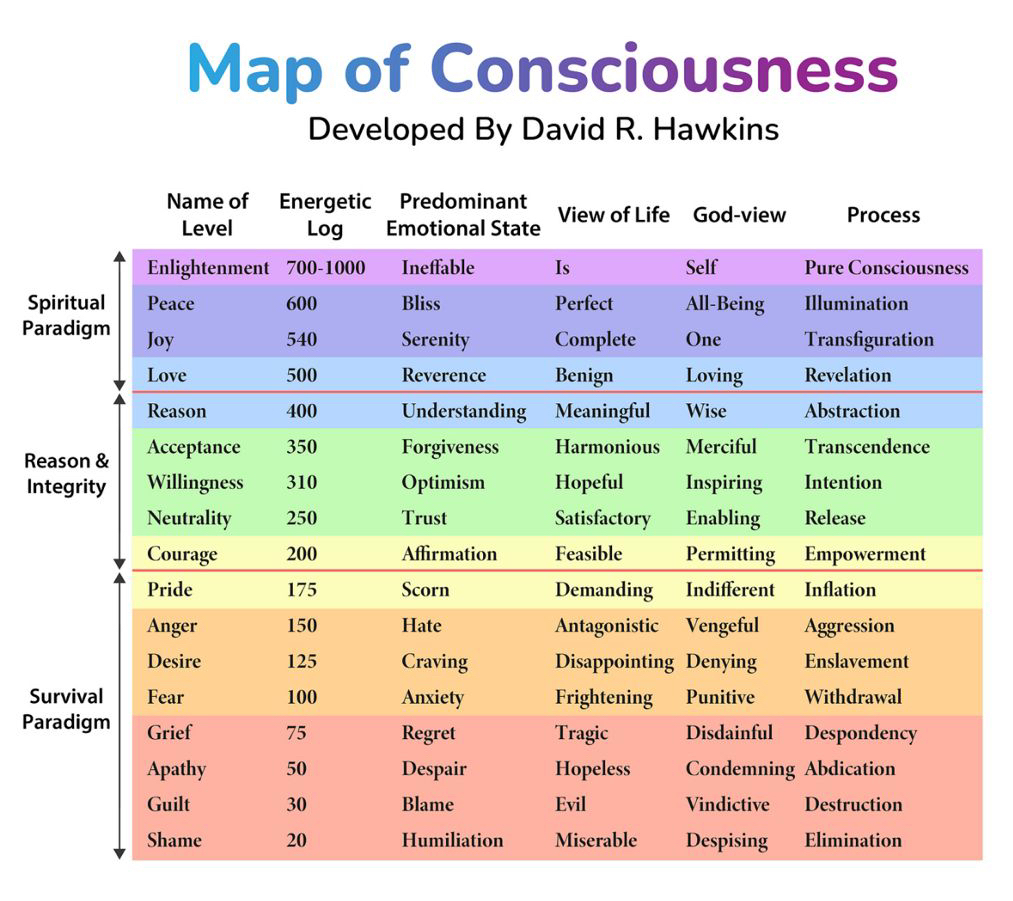
Adapted educational chart based on Dr. David R. Hawkins’ original calibration model from Power vs. Force (1995). This modern infographic summarizes the progression of awareness from Shame (20) to Enlightenment (700–1000).
At the bottom lie the lowest states of consciousness, which Hawkins described as energetically weakening, destructive, and aligned with falsehood.
Shame (calibrated at 20) is the lowest: a state of humiliation, worthlessness, and despair, linked with self-annihilation.
Above it is Guilt (30), associated with blame, self-condemnation, and moral collapse.
Apathy (50) follows, marked by hopelessness and resignation.
Grief (75) embodies sorrow and loss.
Fear (100) narrows perception into avoidance and anxiety.
Desire (125) fuels craving and addiction, the restless pursuit of satisfaction.
Anger (150) brings defiance, but also conflict and destruction.
Pride (175) is the last of the “negative” states—apparently strong but, in Hawkins’ framing, still fragile because it depends on external validation and superiority.
Together, these levels form what he considered the lower band of human existence: self-limiting, corrosive, and energetically weakening.
At 200 comes the critical threshold: Courage. Hawkins cast this as the dividing line between weakness and strength, falsehood and truth, contraction and expansion.
Below 200, he claimed, states drain energy from both the individual and the collective. At 200 and above, states begin to sustain life, foster growth, and align with higher fields of truth. Courage represents the willingness to face life rather than shrink from it, to engage constructively rather than destructively. It is, in his scheme, the pivot point of evolution.
From there, the scale ascends into progressively higher modes of consciousness.
Neutrality (250) embodies flexibility and non-attachment, a capacity to adapt without being trapped in extremes.
Willingness (310) reflects openness, cooperation, and constructive engagement.
Acceptance (350) marks the shift into responsibility, the ability to see life as workable and meaningful.
Reason (400) introduces intellectual clarity and rational problem-solving, encompassing the heights of science and philosophy. Hawkins placed much of modern achievement—law, medicine, education—within this band. Yet even Reason, he argued, has limits, for it cannot by itself reach the transpersonal. The higher rungs carry the explicitly spiritual tones.
Love (500) is not personal affection but unconditional benevolence, radiating care without demand.
Joy (540) describes inner peace, gratitude, and a sense of effortless flow.
Peace (600) represents serenity, transcendence, and detachment from worldly turbulence.
Above 700, the scale enters the domain of Enlightenment—a state Hawkins reserved for the great mystics of history. Figures like Jesus, the Buddha, and Krishna were assigned calibrations of 1000, the theoretical maximum, representing the full realization of unity with the Divine. In this framing, enlightenment is not just one possibility among many but the apex of measurable consciousness.
━━━━━━━━━━━━━━━ ✦ ━━━━━━━━━━━━━━━
꩜ Functional Role of the Scale
Hawkins framed the scale as both diagnostic instrument and evolutionary roadmap, something that could be applied to individuals, communities, ideas, and even entire civilizations. Its functional role was to give seekers a way to measure consciousness, orient themselves on a path of growth, and distinguish truth from falsehood in a world of confusion. It was pitched not just as a model but as a living gauge of reality.
At its most immediate, the scale functions as a personal diagnostic. By knowing one’s “calibration,” a person could supposedly identify the general field they lived in—whether trapped in fear, driven by anger, stabilized in reason, or opening into love and joy. The appeal here is obvious: spirituality is often vague, subjective, and full of competing claims. Hawkins’ scale offered a shortcut. Instead of endless ambiguity, you had a number. Instead of wondering if your progress was “real,” you could point to where you stood on the ladder. For many, this gave a sense of clarity and legitimacy to their inner work.
Beyond the personal, the scale functions as a truth-detector. Hawkins claimed that through applied kinesiology, one could test the veracity of any statement, book, teaching, or teacher. If a muscle response “held strong,” the calibration was high and aligned with truth; if it “went weak,” it was low and aligned with falsehood. In this way, the scale promised something no other spiritual system dared: an objective method for sorting truth from illusion. To his followers, this turned spirituality into something measurable, giving them a compass in a landscape of conflicting doctrines.
The scale also functions as a moral hierarchy. By framing levels below 200 as destructive and levels above 200 as constructive, Hawkins provided a simple moral compass: what weakens life is false, what strengthens life is true. This allowed adherents to recast ethics in terms of energy rather than dogma. It wasn’t about commandments or cultural norms but about measurable alignment with life-force. In this sense, the scale became a secular-sacred ethic: “live above 200” became shorthand for living in truth.
On a collective level, the scale functions as a diagnosis of history and culture. Hawkins applied it not just to people but to entire civilizations, claiming to calibrate nations, religions, and social movements. He argued that most of humanity lived below 200 until the mid-twentieth century, when the global average crossed into Courage. This narrative gave history an upward trajectory, suggesting that collective evolution was measurable and that humanity was on the cusp of a new stage. The functional role here was mythic as much as diagnostic: the scale offered a story of progress, a reassurance that despite chaos, consciousness was rising.
For seekers, the scale’s functional role is psychological as much as spiritual. It simplifies the chaos of human development into a single ladder, giving people a sense of place and direction. It provides motivation: moving “up the scale” becomes both a spiritual goal and a measure of success. And it creates community: within Hawkins’ circles, “calibrations” became a common language, a way of comparing teachers, books, or even political movements. The function was less about proof and more about orientation—helping people feel that growth is quantifiable, progress is real, and truth has a map.
━━━━━━━━━━━━━━━ ✦ ━━━━━━━━━━━━━━━
꩜ Human Interaction with the Scale
The Scale has become a living tool for thousands of people who interact with it in workshops, coaching sessions, spiritual circles, and personal reflection. Its appeal lies in its apparent simplicity: complex inner states can be translated into clean numbers, and progress on the spiritual path can be tracked like miles on a gauge. This interaction has given the scale both its vitality and its danger.
On the personal level, many use the scale as a self-assessment tool. Readers of Power vs. Force often place themselves on the ladder intuitively—“I must be around 300,” “I want to reach 500,” and so on. In spiritual coaching, clients are sometimes told their “current calibration,” with the suggestion that practices like meditation, forgiveness, or surrender will raise their level. This creates a gamified relationship with consciousness: life becomes about climbing the ladder, seeking to reach acceptance, love, or enlightenment as if leveling up in a video game. For some, this provides motivation and hope; for others, it breeds pressure, comparison, and self-judgment.
In group contexts, the scale is used as a shorthand language. Followers of Hawkins or integrally-informed coaches might describe events in terms of calibration—“that speech was below 200,” “this teacher is at 500,” “this movement resonates at 350.” The effect is both bonding and divisive: it gives communities a common vocabulary, but it also risks slipping into elitism, where people or ideas are dismissed simply because they are “low-calibrated.” Within some circles, the scale becomes not just a diagnostic but a social hierarchy.
In practical coaching and healing, the scale is sometimes wielded as a measuring stick of truth. Practitioners claim to use muscle testing to determine whether a client’s belief is aligned with truth or falsehood, then assign a calibration. This can influence decisions about relationships, careers, or spiritual practices. For those who trust it, this feels empowering—an objective guide in uncertain terrain. For skeptics, it raises ethical red flags: people may abdicate judgment to the scale, letting a supposed number dictate choices that should involve discernment and nuance.
Another way people interact with the scale is aspirationally. Many do not care whether the numbers are objectively real; they use the ladder as a metaphorical goalpost. The idea of moving from fear (100) to courage (200) to love (500) provides a narrative of growth, even if one doubts the exact calibration. In this way, the scale functions less as measurement and more as inspiration. Its interaction here is motivational, helping people visualize an upward trajectory rather than feeling lost in the chaos of emotional life.
Yet the interaction is not always constructive. The scale can be misused as a weapon of judgment. Labeling someone as “below 200” easily becomes a dismissal: their ideas are false, their perspective is weak, their presence is toxic. This reinforces spiritual elitism, dividing people into “low-vibe” and “high-vibe” categories, often without compassion for the complexity of human suffering. The risk is that what was framed as a tool for evolution becomes a hierarchy of superiority. Hawkins’ followers sometimes fell into this trap, wielding calibrations as final verdicts rather than provisional metaphors.
Ultimately, human interaction with the Hawkins Scale reveals both its allure and its peril. People are drawn to it because it simplifies spirituality, gives them a sense of progress, and offers a way to navigate confusion. But the very simplicity that makes it accessible also makes it easy to misuse. For some, it is a ladder of inspiration; for others, a cage of numbers. How it functions depends less on the theory itself and more on how individuals and communities choose to apply it.
━━━━━━━━━━━━━━━ ✦ ━━━━━━━━━━━━━━━
꩜ Purpose and Esoteric Function
Hawkins believed he had uncovered a fundamental law of the universe: that consciousness itself exists on a measurable spectrum, and that truth and falsehood are not abstract debates but energetic realities with quantifiable effects. His purpose was not only to map human psychology but to expose what he saw as the underlying structure of consciousness itself.
At its core, the esoteric claim of the scale is that truth strengthens, falsehood weakens. In Hawkins’ view, every thought, statement, or action carries an energetic signature. When aligned with truth, that signature resonates in a way that empowers life; when aligned with falsehood, it drains vitality. This principle was dramatized through applied kinesiology, where a “weak muscle” supposedly exposed falsehood and a “strong muscle” confirmed truth. For Hawkins, this was not anecdote but evidence of a universal principle: reality itself calibrates in response to integrity.
From this foundation, the scale’s purpose expanded. It was designed to serve as a moral compass—a way to distinguish constructive from destructive states, to show humanity the consequences of its choices. By situating emotions, worldviews, and spiritual states on a continuum, Hawkins provided what he believed was an objective standard of value. Shame and guilt weaken life, courage and love strengthen it. In his framing, morality was no longer subjective preference or religious decree but a measurable alignment with truth. The esoteric function was to collapse ethics into physics: good and evil became energetics.
Beyond individual application, the scale was also meant as a collective revelation. Hawkins claimed that for most of history, humanity’s average level of consciousness remained below 200—trapped in fear, anger, and pride. Only in the mid-twentieth century, he argued, did the collective calibration cross into Courage, opening the door to global transformation. His purpose here was prophetic: the scale was not only a diagnostic but a story of human destiny, proof that we are evolving upward and that higher consciousness is slowly reshaping civilization. It functioned as reassurance in an era of crisis—evidence, at least for his followers, that the tide was turning.
The scale also had a distinctly esoteric function in spiritual practice. By placing love at 500, joy at 540, peace at 600, and enlightenment between 700 and 1000, Hawkins offered a ladder for mystics and seekers. He implied that higher calibrations opened access to non-dual states and unity with the Divine. His own life, he suggested, had stabilized above 700, allowing him to live in permanent awareness of the Absolute. The purpose here was aspirational: the scale was meant to chart not just ordinary growth but the path to enlightenment itself. In Hawkins’ framing, this was not theology or faith but the measurable physics of awakening.
Taken as a whole, the purpose of the Hawkins Scale was to reframe spirituality as science of consciousness. It was meant to cut through skepticism, to bypass endless debates over belief systems, and to provide what Hawkins described as a “calibration of truth” that anyone could replicate. Its esoteric function was to reveal consciousness as a field that saturates reality, a field that can be mapped, measured, and ultimately mastered.
Whether one sees this as revelation or overreach depends on one’s stance. To his followers, Hawkins had unveiled a cosmic law that merged mysticism with measurement. To his critics, he had dressed metaphysics in scientific clothing. Either way, the purpose was clear: the scale was not intended as metaphorical inspiration but as a definitive law of consciousness, a ladder by which humanity might orient itself toward truth, integrity, and ultimate enlightenment.
━━━━━━━━━━━━━━━ ✦ ━━━━━━━━━━━━━━━
꩜ Criticisms and Limits
The Hawkins Scale has inspired devotion, but it has also drawn sharp criticism. Its bold claim—to measure consciousness numerically from 0 to 1000—invites skepticism, and when examined closely, the foundations of the system prove fragile. What looks like a scientific breakthrough collapses under scrutiny into a mixture of subjectivity, oversimplification, and spiritual elitism.
The most immediate critique is scientific invalidity. Hawkins based his method on applied kinesiology, a practice widely dismissed by mainstream science. Muscle testing has repeatedly failed replication studies; results vary depending on the practitioner, the subject, and even the expectations of those involved. Controlled experiments show that subconscious biases can influence the outcome. Hawkins, however, treated these responses as objective proof of universal law, a leap that cannot be sustained. The numbers on his scale were not measurements in the scientific sense but interpretations of muscle twitches. As such, the empirical foundation of the scale is weak at best, non-existent at worst.
A second limit is over-simplification. Human consciousness is multidimensional, recursive, and context-dependent. To compress the full spectrum of human experience into a single numerical ladder flattens nuance into caricature. Grief, for example, may calibrate “low” in Hawkins’ scheme, yet grief can be transformative, deepening compassion and awakening resilience. Anger, while coded as destructive, has historically fueled justice movements and broken cycles of oppression. By assigning fixed numbers, the scale risks mislabeling complex states as “bad” or “weak,” when in reality their meaning depends on context and integration.
Another critique is spiritual elitism. Hawkins drew a hard line at 200, declaring everything below as destructive and everything above as constructive. This binary fosters a subtle hierarchy of worthiness: those “above 200” are aligned with truth, while those “below 200” are essentially defective. In practice, this can lead to spiritual judgment, where people dismiss others—or entire groups—as “low-calibration” and therefore unworthy of serious engagement. The rhetoric of “raising your vibration” easily slips into superiority, bypassing the messy work of compassion. The very emotions that make us human become stigmatized as failures to transcend.
The scale also suffers from historical and theological overreach. Hawkins claimed to calibrate not only individuals but entire religions, books, and historic figures. He placed Jesus and the Buddha at 1000, while rating other traditions and leaders far lower. These pronouncements are unverifiable and rest entirely on his own interpretations. They carry the aura of authority without any mechanism of accountability, essentially turning one man’s claims into cosmic verdicts. Critics rightly argue that this crosses from metaphysics into dogma, cloaked in the language of science.
A further limit is psychological hazard. By giving people a number for their consciousness, the scale can induce obsession or despair. Some fixate on “climbing the ladder,” reducing spiritual life to scorekeeping. Others, told they are “below 200,” may internalize a sense of failure or unworthiness. Spiritual growth, which is inherently fluid and non-linear, becomes distorted into a rigid, competitive metric. The tool that promises liberation can become a trap of self-judgment and hierarchy.
Finally, the scale is culturally narrow. It privileges a Western, individualistic model of progress, framing consciousness as something to be ranked and climbed. Indigenous traditions, Taoist cosmologies, or relational mysticisms do not fit easily into such hierarchies. They value cycles, webs, and balance, not ladders. By presenting his scale as universal, Hawkins inadvertently excluded entire ways of knowing. His attempt at objectivity became another cultural projection, a mirror of Western obsession with measurement and control.
In sum, the Hawkins Scale is compelling as symbol but fragile as truth. Its numbers cannot be scientifically verified; its hierarchy oversimplifies and stigmatizes; its claims to universality conceal cultural and personal bias. At its best, it serves as a metaphorical ladder of growth. At its worst, it fosters elitism, bypassing, and misplaced certainty. Its limits are not minor details—they strike at the core of the system. The scale survives not because it is accurate, but because it is simple, bold, and reassuring in a world starved for clarity.
━━━━━━━━━━━━━━━ ✦ ━━━━━━━━━━━━━━━
꩜ Cross-Mapping to Other Systems
The Hawkins Scale of Consciousness is not unique in its attempt to rank or order the inner life. It stands in a long tradition of maps that imagine consciousness as layered, developmental, and hierarchical. Placing it against other systems shows both what it absorbs and what it flattens.
The most obvious parallel is with Theosophy’s planes of existence. Both present consciousness as a ladder, moving from dense, destructive states toward unity with Spirit. Theosophy spoke of physical, astral, mental, buddhic, and atmic planes; Hawkins compressed this into numbers, from shame through love to enlightenment. In both cases, progress is upward, and higher equals truer. But where Theosophy clothed its claims in mystical cosmology, Hawkins dressed his in scientific language. The scaffolding is similar, but the packaging reflects the cultural moment: Theosophy spoke to a Victorian fascination with hidden worlds; Hawkins spoke to a late-modern hunger for measurement.
The scale also echoes Integral Theory, particularly Wilber’s model of developmental levels. Hawkins’ “below 200” states resemble Wilber’s prepersonal stages—ego-driven, fear-based, limited. His “above 200” levels align loosely with Wilber’s personal and transpersonal stages, where integration, compassion, and non-duality emerge. Both systems frame consciousness as an evolutionary arc, with courage or worldcentric awareness as the turning point. The difference lies in scope: Wilber’s AQAL is sprawling and systemic, Hawkins’ ladder is narrow and numeric. One aims for complexity; the other for simplicity.
The Buddhist tradition also casts a long shadow. Hawkins’ upper levels—peace (600), enlightenment (700–1000)—mirror descriptions of meditative absorption and nirvanic realization. His language of detachment, surrender, and unity with the Divine borrows heavily from Buddhist and Vedantic non-duality. Yet Buddhism is wary of hierarchies that assign worth to emotions; suffering itself can be the path to awakening. Hawkins’ numerical coding risks turning what Buddhism treats as universal capacities into rigid rankings.
In Christian thought, the echoes are moral as much as mystical. The lower levels of shame, guilt, and fear resonate with the language of sin, bondage, and separation from God. The higher levels of love, joy, and peace reflect the fruits of the Spirit. Hawkins recasts these biblical motifs into energetic calibrations, stripping them of theological context but retaining their basic moral polarity. His claim that Jesus calibrates at 1000 mirrors the Christian belief in Christ as the ultimate exemplar of divine consciousness.
By contrast, indigenous and shamanic cosmologies resist this linear framing. Where Hawkins sees a single ladder from low to high, many traditions describe cycles of renewal, webs of relationship, or three-world models (upper, middle, lower). Here, grief or anger may not be “low” but sacred, necessary forces. Taoism likewise resists hierarchy: yin and yang are not steps on a ladder but polar flows to be balanced. Hawkins’ scale flattens these into “weak” vs. “strong,” missing the subtler dynamics of traditions that value fluidity over ascent.
Cross-mapping makes clear that the Hawkins Scale is not an isolated revelation but a cultural remix. It borrows the ladder from Theosophy, the developmental arc from psychology, the mystical climax from Buddhism, the moral polarity from Christianity, and the aura of measurement from modern science. What it lacks is nuance. Where older systems used myth, ritual, or paradox to hold complexity, Hawkins compressed everything into a single column of numbers. The appeal is obvious—it is portable, clear, decisive—but the cost is reduction. What survives is not the fullness of tradition but a stripped-down hierarchy dressed in scientific clothing.
━━━━━━━━━━━━━━━ ✦ ━━━━━━━━━━━━━━━
꩜ Contemporary Relevance
Decades after its introduction in Power vs. Force, the Hawkins Scale remains alive in spiritual and self-help culture. It appears in coaching programs, healing workshops, online courses, and New Age communities. Even critics who dismiss its scientific claims acknowledge its enduring influence. The persistence of the scale says less about its accuracy and more about its cultural resonance: it gives modern seekers what they crave—clarity, certainty, and a sense of measurable progress.
In coaching and personal development, the scale functions as a motivational ladder. Life coaches and spiritual mentors often use its levels as shorthand for describing growth: moving clients from “fear at 100” to “acceptance at 350” becomes a narrative arc of transformation. The numeric values give the impression of objectivity, helping clients feel that progress is not just emotional but quantifiable. For many, this reframing provides comfort: instead of drowning in ambiguity, they can track their evolution like a score.
In spiritual communities, the scale has become a kind of vernacular. Phrases like “living above 200” or “raising your vibration” echo Hawkins’ influence, even among those who have never read his books. The language of “calibration” circulates in discussions of teachers, movements, and even politics. Within New Age circles, it often serves as both aspirational mantra and boundary marker—distinguishing “high-vibe” people from “low-vibe” ones. The scale thus shapes not only self-perception but group identity, reinforcing shared values through a common metric.
The scale also remains relevant because it simplifies spirituality. In an era flooded with information—where meditation, neuroscience, quantum mysticism, and esoteric traditions compete for attention—the Hawkins Scale offers a clean, digestible model. It reduces complexity into a continuum that is easy to visualize and easy to remember. For seekers overwhelmed by the fragmentation of spiritual options, this simplicity is powerful. Even if they doubt the literal numbers, the metaphor of moving “up the scale” provides direction.
Another reason for its endurance is its role as a story of collective evolution. Hawkins claimed that humanity’s average consciousness crossed the 200 threshold in the late twentieth century, signaling a global shift toward courage and truth. Many find hope in this narrative. In a time marked by ecological crisis, political division, and cultural upheaval, the idea that consciousness itself is rising offers reassurance. The scale functions here less as measurement than as myth: a modern parable of human progress.
At the same time, the scale’s relevance is contested. Critics within psychology and academia dismiss it as pseudoscience. Some spiritual teachers reject its rigidity, arguing that it reduces sacred experience to numbers. And yet, these critiques have not stopped its spread. Its language continues to resonate because it meets an emotional need: it helps people feel oriented in a confusing world. Whether accurate or not, it provides a framework that makes growth seem tangible.
Ultimately, the Hawkins Scale remains relevant not because it is provable, but because it is usable. It has seeped into the grammar of modern spirituality, shaping how people talk about emotions, truth, and growth. It functions less as a scientific discovery and more as a cultural meme—a tool for orientation, a story of ascent, a vocabulary of hope. In that role, it continues to live, even in the shadow of its limitations.
━━━━━━━━━━━━━━━ ✦ ━━━━━━━━━━━━━━━
꩜ Closing
The Hawkins Scale of Consciousness is one of the most striking attempts of the late twentieth century to compress the vastness of inner life into a single continuum. Its appeal is obvious: it promises clarity in a domain notorious for vagueness. By assigning numbers to emotions, worldviews, and spiritual states, it gives seekers a ladder to climb and a compass to navigate by. It is easy to understand, easy to remember, and easy to apply. That simplicity is the secret to its influence.
What the scale is, at its best, is a symbolic map—a psychological-spiritual ladder that captures the intuition that some states empower life while others diminish it. It is a motivational tool, giving people a sense of progression from fear to courage, from pride to love. It is a cultural meme that continues to shape the vocabulary of modern spirituality, providing common language for ideas like “raising vibration” or “living above 200.” It is also a myth of collective evolution, telling a story of humanity’s rise from darkness into light. In these roles, the scale has value: not as measurement, but as metaphor.
But what the scale isn’t is what Hawkins claimed it to be. It is not a scientific calibration of consciousness. The muscle-testing method it rests on is unreliable and unrepeatable. The numbers are not measurements but interpretations. It is not a definitive map of human growth: grief, anger, and other “low” states can be transformative, while “high” states can mask denial or bypassing. Nor is it universal: it reflects a Western, hierarchical worldview that does not easily encompass cyclical, relational, or non-linear traditions. The scale may inspire, but it cannot prove.
The danger is in mistaking metaphor for law. When the scale is wielded as objective truth, it becomes a tool of judgment and exclusion, dividing people into “low” and “high,” dismissing complexity in the name of calibration. When taken flexibly, it can inspire growth. When taken literally, it distorts.
In the end, the Hawkins Scale endures not because it solved the problem of measuring consciousness, but because it tells a story people need. It reassures them that life has direction, that truth strengthens, that love is higher than fear. It is not physics; it is parable. Its power lies not in its numbers but in its narrative. To use it wisely is to see it for what it is: a provocative metaphor for human development, not a ruler of the soul.


 The Sacred Spiral Co.
Leave a comment