The chakra system is one of the most widely recognized frameworks in modern spirituality. Yet what most people know about chakras—the seven rainbow-colored wheels running from base to crown—is a recent invention, far removed from its origins. The popular version that circulates in yoga studios, crystal shops, and social media posts is a simplification layered with distortions. It is not false, but it is incomplete, fragmented, and often misleading.
To understand the chakra system fully, we must look beyond the polished New Age surface and trace its history. We must return to the earliest references in the Indian scriptures, examine how different Tantric lineages mapped the subtle body, and see how Tibetan Buddhism, Daoism, and other traditions developed their own versions of energy centers. We must follow the trail of appropriation into Western esotericism—Theosophy, occultism, and the New Age movement—that reframed chakras in rainbow colors and psychological archetypes.
The truth is this: chakras are not universal, fixed anatomy. They are symbolic and functional models. They are maps of consciousness and energy, shaped by culture, lineage, and purpose. In India alone, there were multiple chakra systems— other cultures mapped their own energy wheels. What became the “standard” seven-chakra rainbow model is a twentieth-century Western hybrid, not an ancient universal.
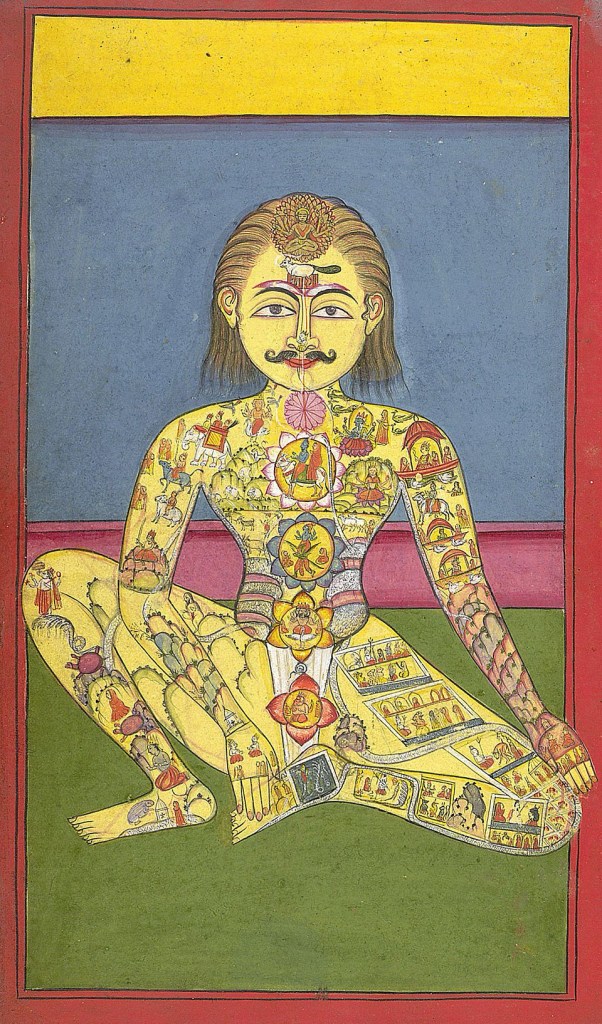
“Sapta Chakra,” yoga manuscript illustration (1899, Braj Bhāṣā). Later visual codification of chakras. Public domain via The British Library / Wikimedia Commons.
This essay is not about debunking chakras, but about clarifying them. It will trace their origins, chart their evolution, dissect their mechanics, expose distortions, and situate them within cross-cultural contexts. It will also explore their deeper esoteric functions—as maps of consciousness, karmic seals, and tools for transformation.
The goal here is precision. No lens, no mystification, no reduction. Just the full truth of how the chakra system arose, how it has been reshaped, and how it continues to function as a living framework for understanding energy and consciousness.
━━━━━━━━━━━━━━━ ✦ ━━━━━━━━━━━━━━━
꩜ Origins in Ancient Traditions
Vedic Foundations
The earliest seeds of the chakra system are found in the Vedic tradition of India, though the word cakra (Sanskrit: चक्र) originally meant simply “wheel” or “disc.” In the Rig Veda, cakra appears in reference to the Sun’s wheel, the wheel of time, and the cycle of cosmic order—not specifically energy centers in the body. The leap from cosmic wheels to subtle-body wheels would come later.
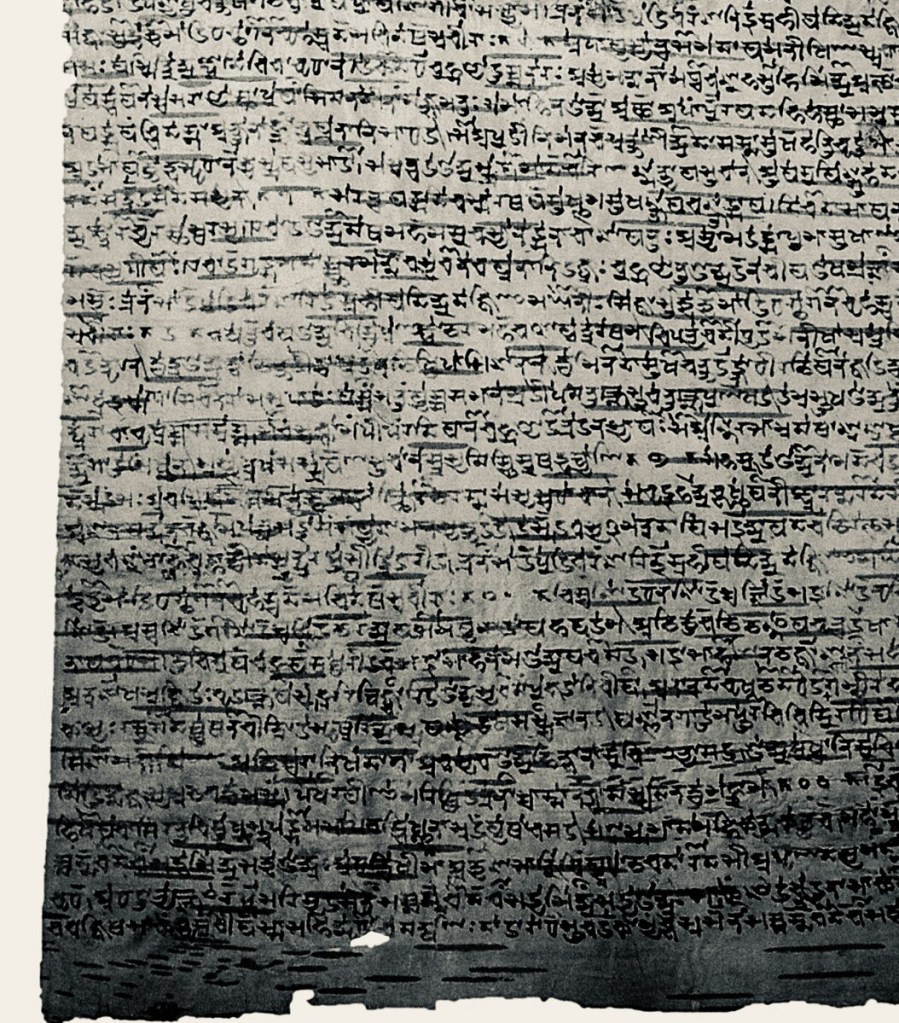
Rig Veda manuscript leaf (Sanskrit, Śāradā script). Early Vedic use of cakra as “wheel,” not bodily chakras. Public domain via Wikimedia Commons.
The Upanishads, particularly the Yoga Upanishads (1st millennium CE), are the first texts that directly connect the concept of cakra to the human body. Here, the subtle body (sūkṣma śarīra) is introduced, with its channels (nadis) and flows of life-force (prana). These texts describe wheels or lotuses along the spinal axis, where energy gathers and radiates.

12th-century Advaita bhāṣya on the Nārāyaṇa Upanishad (Malayalam/Grantha scripts), PD via Commons.
However, these early sources do not present a fixed system of seven chakras. Some Upanishads describe only a handful of centers, and the functions vary. What they share is the idea that the body is a microcosm of the cosmos, with its own wheels of energy mirroring larger cosmic cycles.
Tantric Development
It was in Tantric traditions (roughly 6th–13th century CE) that the chakra system began to take a recognizable shape. The Tantras developed subtle-body maps with varying numbers of chakras, mantras, deities, and visualizations.
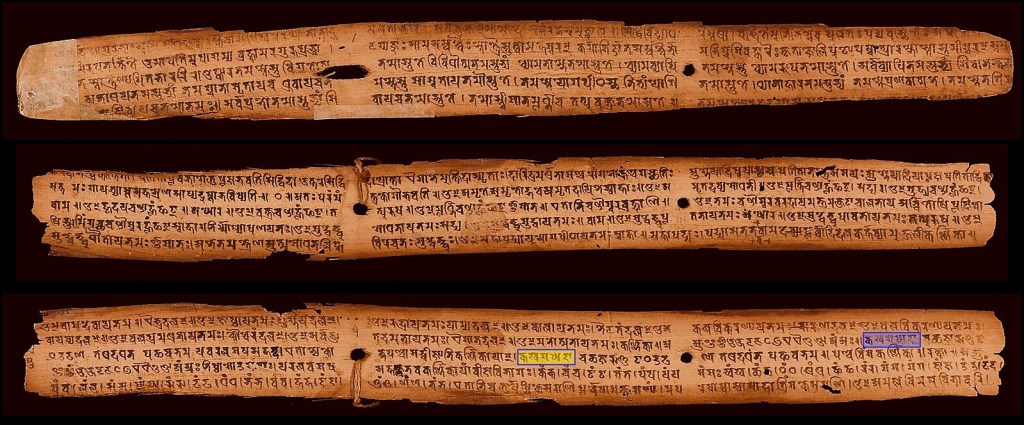
Parameśvaratantra palm-leaf manuscript, 828 CE (Late Gupta script, Nepal). Early Śaiva tantric source; the tantric corpus develops detailed chakra mappings. Public domain via Wikimedia Commons.
In Tantra, chakras were not abstract psychological centers. They were specific ritual sites within the subtle body where mantras, deities, and yantras were installed through practice. Each chakra was a cosmological hub: petals representing Sanskrit syllables, a presiding deity, an element (earth, water, fire, air, ether), and an associated sound vibration.
Tantric practice saw chakras as functional gateways for transforming the body into a vessel for liberation. They were not colorful meditations but complex ritual technologies.
━━━━━━━━━━━━━━━ ✦ ━━━━━━━━━━━━━━━
꩜ Historical Evolution of Chakra Models
Indian Variations
The chakra system was never fixed. Different texts and lineages gave different maps:
5-Chakra Systems Some early Tantric texts describe only five main centers. These often corresponded to the five great elements (mahabhutas): earth, water, fire, air, and ether.
6-Chakra Systems The Ṣaṭ-Cakra-Nirūpaṇa (“Description of the Six Chakras,” c. 16th century) is one of the most famous. It described six chakras along the spine, with a seventh, the sahasrara (thousand-petaled lotus), above the crown. This model became highly influential in later yoga and Tantra practice.
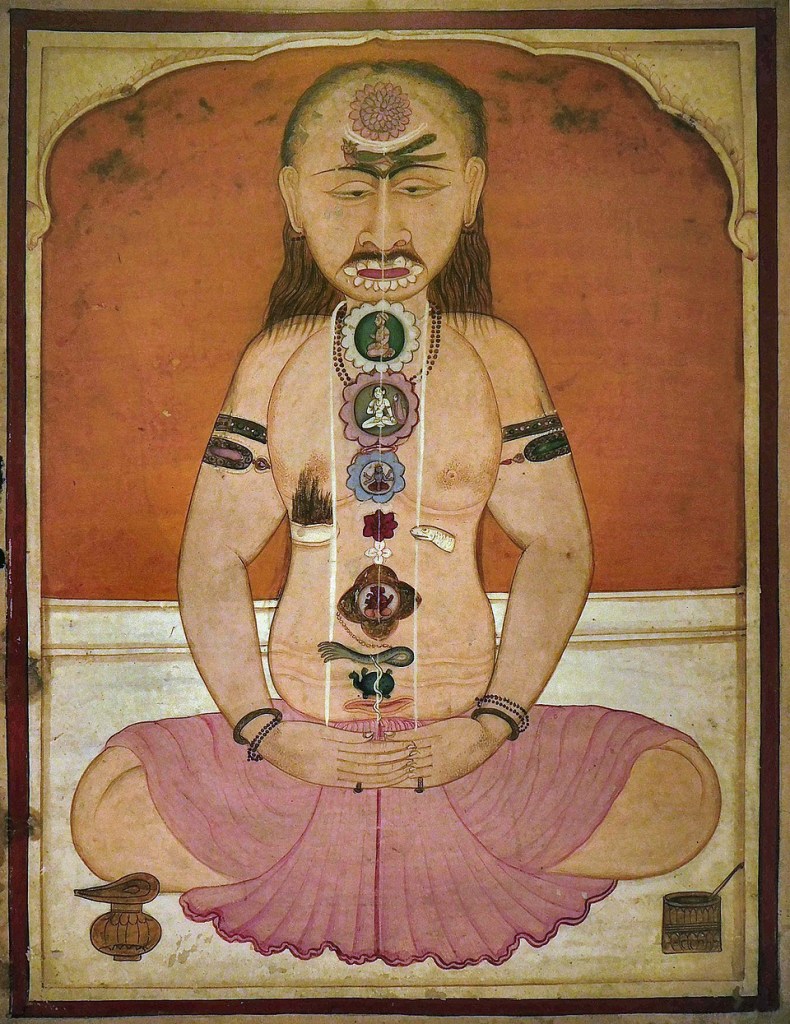
Yogin in meditation showing chakras, three main nāḍīs, and the kundalinī serpent. Public domain / Wikimedia Commons.
7-Chakra Systems The idea of a “standard” seven-chakra system comes later and is not consistent across all traditions.
Some lineages describe 9, 10, 12, or even more chakras, often linked to cosmic or divine levels beyond the human frame. These were not “extra chakras” in the New Age sense, but expanded ritual maps.
The key truth: there was never a single universal chakra map in India. Different schools produced different systems depending on their ritual focus.
Tibetan Influence
When Tantric Buddhism migrated into Tibet (8th century onward), the chakra concept was adopted but remapped. Tibetan subtle-body systems emphasize:
Four primary chakras: crown, throat, heart, navel.
Different colors and functions than Indian models. Practices like tsa-lung and tummo that work with channels (tsa), winds (lung), and drops (thigle).

Tibetan medical thangka (c. 18th century) showing subtle-body channels (tsa), winds (lung), and energy centers. Tibetan traditions emphasized four primary chakras. CC BY 4.0 via Wellcome Collection / Wikimedia Commons.
Thus, while both Indian and Tibetan yogas speak of chakras, their systems diverge significantly.
Western Esoteric Adaptations
The chakra system took a radical turn when it was introduced to the West in the late 19th and early 20th centuries.
Theosophy Helena Blavatsky (1831–1891) and later C.W. Leadbeater (1854–1934) presented chakras through clairvoyant “visions.” Leadbeater’s book (The Chakras (1927) ) reinterpreted them in terms of colors, spinning wheels, and psychic functions.
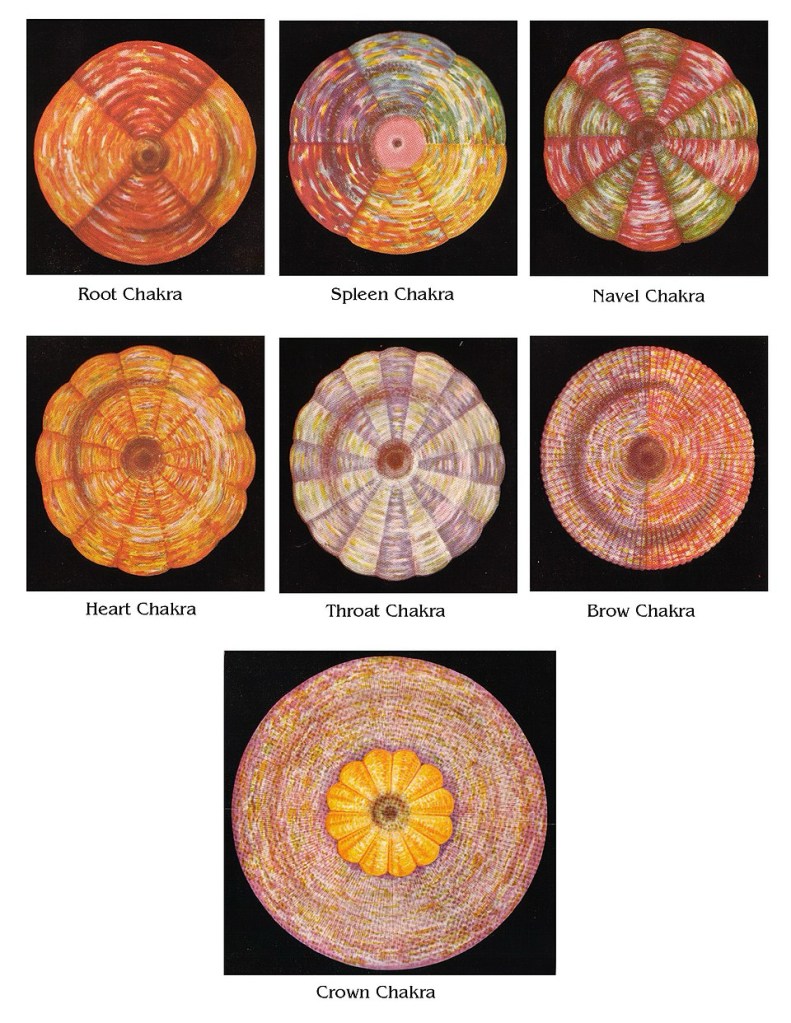
Leadbeater’s chakra illustrations from The Chakras (1927). Public domain via Wikimedia Commons.
This was a major shift: chakras became part of an occult anatomy that blended Indian Tantra with Western Hermeticism. Psychological Reframing By the mid-20th century, chakras were aligned with Western psychology. Carl Jung spoke of chakras in terms of archetypes and individuation. This reframed them as developmental stages of consciousness rather than ritual deities or mantras.
The Rainbow System
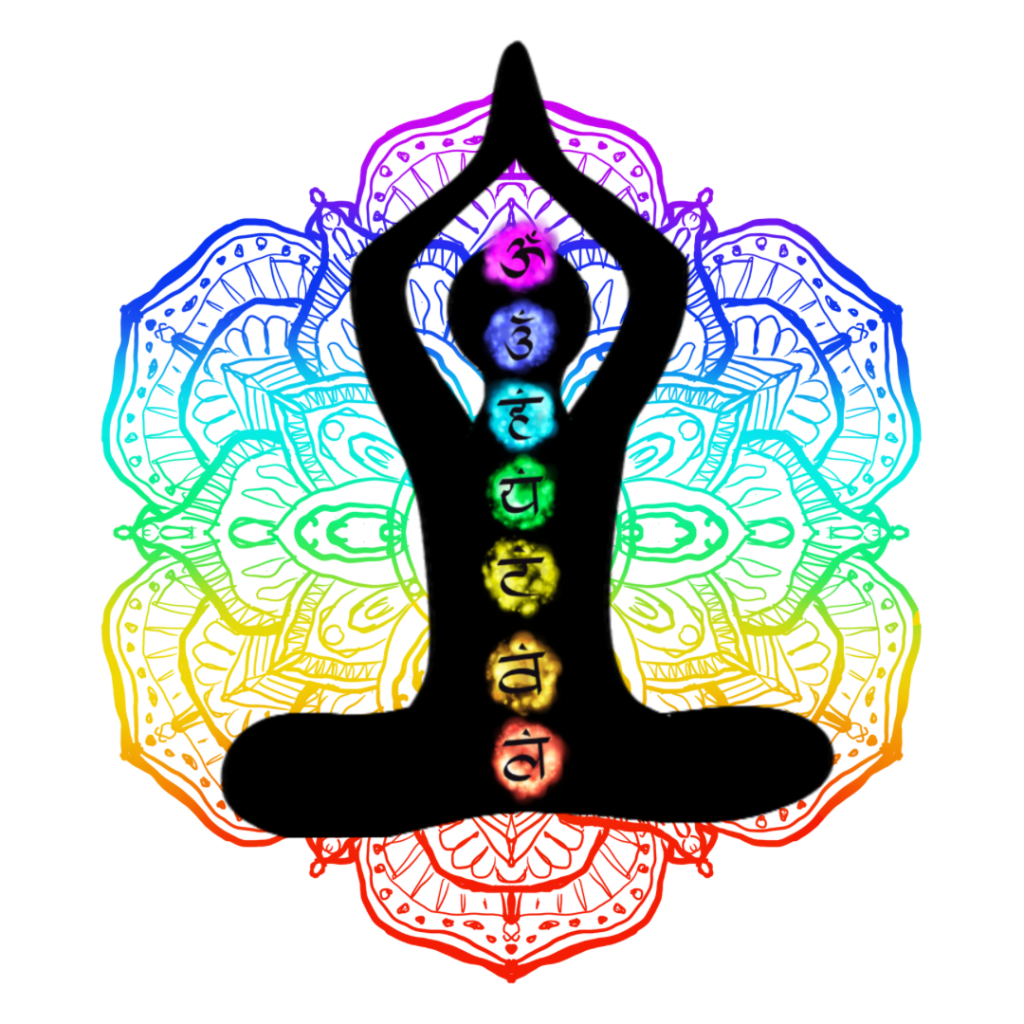
The most familiar chakra map—the seven rainbow-colored chakras—popularized by Christopher Hills in his book Nuclear Evolution (1977). Hills directly linked the seven chakras to the seven colors of the visible spectrum (ROYGBIV).
This color-coding had no precedent in Indian or Tibetan sources. It was a Western invention, heavily influenced by New Age cosmology and modern metaphysics. The rainbow system stuck because it was simple, memorable, and visually appealing. By the 1980s–90s, it had become the global “standard,” despite its lack of traditional roots.
━━━━━━━━━━━━━━━ ✦ ━━━━━━━━━━━━━━━
꩜ Core Mechanics of Chakras
Energetic Function
At their essence, chakras are vortices of prana—life force—that operate within the sūkṣma śarīra (subtle body). They are not physical organs, but energetic nodes where channels converge, creating whirlpools of energy. Each chakra functions as:
Interface: Linking physical body, energy body, and consciousness.
Filter: Translating raw cosmic energy into usable human form.
Hub: Governing specific psychological, emotional, and spiritual functions.
Chakras are not fixed like bones—they are dynamic. Their activity expands or contracts depending on attention, breath, practice, or suppression.
Nadis and Channels
Chakras do not exist in isolation. They are embedded in the body’s network of nadis (energy channels).
Texts describe 72,000 nadis, though three are primary:
Ida: Lunar, left channel, cooling, feminine.
Pingala: Solar, right channel, heating, masculine.
Sushumna: Central channel running along the spine, conduit for kundalini.
The chakras sit along the sushumna like junction points. Ida and pingala crisscross through them, creating alternating polarities. This triadic current is the basis of kundalini awakening: energy rising through sushumna, piercing each chakra in turn.
Chakras are not the one “true” model. They are one among many human attempts to articulate the interface between body, energy, and spirit. Their value lies not in universality but in specificity—how they capture a particular lineage’s way of working with subtle power.
Petals and Vibrations
Each chakra is symbolized as a lotus with a specific number of petals. These petals are not decorative—they represent vibrations. Each petal corresponds to a Sanskrit varna (syllable), encoding a frequency. For example:
Muladhara (root) = 4 petals (4 vibrations).
Anahata (heart) = 12 petals.
Ajna (third eye) = 2 petals.
Together, the chakras contain the entire Sanskrit alphabet, meaning the human body is seen as a living language, a sound-body. The petals are vibratory gateways through which energy and consciousness manifest.
Deities, Elements, and Seed Sounds
In Tantric practice, chakras are not just wheels of energy—they are populated with deities, elements, and bīja mantras (seed sounds).
Deities: Each chakra houses a presiding god/goddess.
Elements: Root = earth, sacral = water, solar = fire, heart = air, throat = ether.
Seed Sounds: Specific mantras (e.g., lam, vam, ram) act as activation codes.
This is why chakras in their original context were never “abstract psychology.” They were ritual cosmologies—each one a temple.
The Dynamics of Flow
A chakra is not “open” or “closed” in a binary sense. It oscillates. It can be:
• Overactive (energy excess, distortion).
• Underactive (energy deficiency).
• Balanced (harmonic flow).
Health in the chakra system is not about prying them all open, but about harmonizing flow. Too much focus on opening without grounding leads to instability. Too much suppression leads to stagnation.
Chakra–Body Interfaces
Chakras express themselves physically via two main systems:
Nervous system: Major plexuses correspond to chakra sites.
Endocrine glands: which we will touch on more below.
You will find, chakras can be read both as spiritual centers and as subtle reflections of physical anatomy.
Consciousness Gateways
Each chakra functions as a layer of consciousness:
• Root → survival, grounding.
• Sacral → sexuality, creativity.
• Solar → will, power.
• Heart → love, integration.
• Throat → truth, expression.
• Third Eye → perception, intuition.
• Crown → unity, transcendence.
But this psychological mapping is secondary. In the original tradition, these were gateways of initiation—each chakra marking a threshold of spiritual passage.
Mechanically, chakras are vortices where channels intersect, powered by prana, encoded with sound and symbol, and mirrored in the body’s physiology. They are living gateways.
━━━━━━━━━━━━━━━ ✦ ━━━━━━━━━━━━━━━
꩜ Distortions and Misconceptions
The Rainbow Model
No pre-modern Indian text presents this rainbow scheme. Traditional depictions describe chakras with specific lotus colors, deity images, and symbolic correspondences—not a neat gradient of the visible light spectrum. The rainbow system is an attractive teaching tool, but historically inaccurate.
The Myth of Universality
Another distortion is the belief that chakras are a universal human anatomy—that every person has exactly seven chakras in the same locations. In truth:
The chakra system is a map, not a fixed organ system. Different maps serve different practices. To universalize one model erases the diversity of subtle-body traditions. They are all pieces to a much a larger puzzle.
Commercialization and Pop Spirituality
The modern wellness industry has flattened chakras into consumer objects. Crystals, oils, and affirmations are marketed as “chakra healing kits.” While such tools can be symbolic aids, they strip chakras from their ritual, philosophical, and ethical contexts, causing the confusion and dismal we see in today’s society.
In Tantra, working with a chakra was not casual. It involved mantra initiation, breath mastery, deity invocation, and years of disciplined practice. The modern reduction of chakras to “color meditations” or “affirm your root chakra” misses their depth as complex spiritual technologies.
Overemphasis on Opening
A common misconception is that the goal is to “open all your chakras.” In truth, chakras are not meant to be forced open indiscriminately. Each center is a gate, a lock, and a filter. To fling them wide without balance is like dismantling the body’s firewall. In traditional practice, chakras were awakened gradually under guidance, not through quick techniques.
Mimicry and False-Light Systems
Some esoteric critiques argue that the modern rainbow chakra system functions as a containment grid. Instead of liberating energy, it loops it into predictable patterns that can be siphoned. The oversimplification creates a mimic system—bright, appealing, but limited. This raises the question: who benefits when masses of people adopt a distorted chakra map?
While not all modern chakra work is parasitic, it is important to discern. A false-light overlay can drain rather than empower, especially when paired with commercial exploitation.
Psychological Flattening
Western adaptations often reduce chakras to psychological themes: survival, sex, power, love, expression, vision, transcendence. While useful for self-reflection, this strips away the original ritual complexity. Chakras were never only inner archetypes—they were cosmic stations, linked to deities, syllables, and entire cosmological systems.
━━━━━━━━━━━━━━━ ✦ ━━━━━━━━━━━━━━━
꩜ Scientific & Anatomical Correlates
Endocrine System
A common modern interpretation aligns chakras with the body’s endocrine glands, which regulate hormones and metabolism. While not identical, the parallels are striking:
• Root (Muladhara): Adrenal glands → survival, stress response.
• Sacral (Svadhisthana): Gonads (ovaries/testes) → sexuality, reproduction.
•Solar Plexus (Manipura): Pancreas → digestion, energy metabolism.
• Heart (Anahata): Thymus → immune system, growth, integration.
•Throat (Vishuddha): Thyroid/parathyroid → metabolism, communication.
• Third Eye (Ajna): Pituitary → master gland, regulation of body systems.
• Crown (Sahasrara): Pineal → circadian rhythms, melatonin, mystical states.
This mapping suggests chakras may reflect an ancient intuitive understanding of how energy and consciousness interface with hormonal regulation.
Nervous System Correlations
Chakras also correspond with major nerve plexuses:
• Root: Pelvic plexus.
• Sacral: Hypogastric plexus.
• Solar Plexus: Celiac (solar) plexus.
• Heart: Cardiac plexus.
• Throat: Cervical plexus.
• Third Eye: Carotid plexus.
• Crown: Cerebral cortex and corpus callosum.
These plexuses are nerve hubs where sensory, motor, and autonomic signals converge—mirroring the chakra’s function as an “energetic hub.”
Brain and Consciousness
Modern neuroscience shows links between meditation (including chakra-focused practices) and altered brain states:
• Increased coherence in brainwave patterns.
• Activation of prefrontal cortex and limbic regions.
• Pineal and pituitary glands associated with mystical experiences.
This suggests chakra practice directly modulates brain states, aligning physiological change with consciousness expansion.
Biofield and Electromagnetic Research
The human body generates measurable electromagnetic fields, strongest around the heart and brain. Emerging research in biofield science shows:
The heart produces the body’s largest rhythmic electromagnetic field. EEG and MEG detect brain and nervous system currents as fields. Some experiments detect vortex-like fields around chakra sites, though not yet fully validated.
Chakras may thus represent subtle electromagnetic vortices—energetic phenomena bridging physical and nonphysical.
Breath and Autonomic Regulation
Chakras are activated through breath (pranayama) because breath directly influences the autonomic nervous system.
Slow exhalation activates the parasympathetic system, opening subtle channels. Retention (kumbhaka) creates inner pressure, pushing energy into higher centers.
Breath thus provides the physiological mechanism for chakra modulation.
The chakra model therefore functions as an ancient psychosomatic map, describing in symbolic language what science is only beginning to measure.
━━━━━━━━━━━━━━━ ✦ ━━━━━━━━━━━━━━━
꩜ More Cross-Cultural Comparisons
The chakra system is not the only subtle-body map humanity has produced. Across cultures, people have intuited that the human body is not merely biological but energetic, not merely mechanical but spiritual. Each culture developed its own symbolic architecture to describe these nodal points of power—different in form, but united in principle. To compare them is not to collapse them into one “universal” system, but to recognize a shared truth: the body is a bridge, and energy centers mark the gates of passage.
Chinese Daoist Energy System
In Daoism, the human body is understood as a living alchemical vessel. Rather than dozens of spinning wheels, Daoist maps describe three great furnaces known as the dantian—literally, “elixir fields.”
The Lower Dantian, located below the navel, is the seat of jing (essence). It governs vitality, reproduction, grounding, and the raw fuel of life. The Middle Dantian, at the heart, governs qi (energy). It is the furnace of breath, circulation, emotion, and balance. The Upper Dantian, at the forehead, governs shen (spirit). It houses consciousness, vision, and connection to the eternal.
Daoist practice focuses on refining essence into energy, energy into spirit, and spirit into pure emptiness. Instead of ascending through multiple chakras, the Daoist adept cycles energy through these three fields, creating an inner alchemy that leads to immortality.
This shows a striking contrast: where the Indian system fragmented energy into many smaller centers, Daoism distilled it into three fundamental crucibles. Both paths describe transformation, but through different symbolic architectures.
Tibetan Vajrayana Tsa-Lung
Tibetan Buddhism inherited Tantric teachings from India but reshaped them within its own cosmology. In Vajrayana subtle-body practice, the human system is composed of tsa (channels), lung (winds, or subtle breath currents), and thigle (drops or essences). The chakra concept exists here as wheels (’khorlo), but the Tibetan map emphasizes fewer, more concentrated centers: typically crown, throat, heart, and navel.
One of the most famous practices, tummo or inner heat yoga, focuses on igniting subtle fire at the navel chakra. This fire melts subtle drops stored in the crown, releasing bliss that spreads throughout the body and stabilizes meditative absorption. Unlike Westernized chakra work that often stops at visualization, Tibetan practice treats chakras as literal engines for altering consciousness and physiology. The winds must be mastered, the channels purified, and the drops circulated. The entire system is functional, not decorative—it is a map for enlightenment.
Kabbalah and the Tree of Life
In Jewish mysticism, the Tree of Life presents a vertical ladder of ten sefirot, emanations of divine energy flowing from the Infinite into the world. The sefirot are not described as “chakras,” yet they serve a parallel function: nodal stations connecting human and divine, matter and spirit.
The lowest sefira, Malkuth, represents the foundation—the material world, survival, grounding. The middle sefirot ascend through realms of love (Chesed), power (Gevurah), beauty (Tiferet), and wisdom (Chokhmah). At the summit rests Keter, the crown of divine unity.
The Tree is traversed through meditation and ritual, much like the Tantric ascent through chakras. The difference lies in its framework: where chakras are vortices of energy in the subtle body, the sefirot are emanations of divine qualities woven into creation itself. Yet the structural resonance is undeniable—a vertical path through inner and outer realities, from survival to transcendence.
Indigenous and Ancestral Systems
Indigenous traditions across the world also describe energy centers in the body, though often in different symbolic language.
Native American Medicine Wheels frame the body and spirit within the four directions, each associated with colors, elements, and life stages. Rather than vertical wheels, the body is placed in a circle,
reflecting a worldview where all directions are sacred gateways. African Cosmologies, such as the Yoruba, emphasize the head (ori) as the crown of destiny, the vessel through which divine power flows. The belly and heart are also recognized as spiritual gates tied to ancestors and lineage.
Andean Traditions describe the nawi (“eyes”)—energetic centers in the belly, heart, and forehead that govern perception. Each nawi is a gateway of sight, not of vision alone but of understanding.
Though these systems differ in geometry, they carry the same insight: the human body is not sealed. It is porous to spirit, marked by gates where energy enters, circulates, and transforms.
Universality and Difference
What emerges from comparison is not a single universal system but a recurring pattern. Every culture recognized that energy is organized within the body through nodes of concentration.
This reveals two truths simultaneously:
The human intuition of energetic centers is universal. The way these centers are mapped is cultural, symbolic, and adaptive.
━━━━━━━━━━━━━━━ ✦ ━━━━━━━━━━━━━━━
꩜ Deeper Esoteric Interpretations
Chakras as Maps of Consciousness
The chakra system is often simplified into “levels of psychology,” but in its esoteric roots, it was a cartography of consciousness itself. Each chakra represented not only a part of the body but a layer of reality.
• Muladhara (root): The law of embodiment—the soul taking root in matter.
• Svadhisthana (sacral): The field of desire, creativity, and karmic residue that pulls the soul into cycles of birth.
• Manipura (solar plexus): The fire of individuality—the ego forging itself as a center of will.
• Anahata (heart): The first point of true transcendence—where the human awakens to love and connection beyond survival.
• Vishuddha (throat): The gate of truth—where sound, vibration, and expression become tools of creation.
• Ajna (third eye): The seat of vision—the capacity to perceive reality as it is, beyond appearances.
• Sahasrara (crown): The dissolution of self into unity—the lotus where individual consciousness merges with the absolute.
This ladder was never arbitrary. It is a coded journey: the path of kundalini, rising from earth to sky, from instinct to infinity. In this sense, chakras are not “parts of the body” but “stations of awakening.”
Chakras as Seals and Locks
Another dimension, often hidden from modern interpretation, is that chakras were also conceived as bandhas—locks, knots, or seals. These locks bind consciousness into specific levels of reality. Each chakra is both a gateway and a gatekeeper.
The root seals you into embodiment. The sacral binds you into desire and generational flow. The solar plexus locks you into individuality. The heart seals karmic entanglement through love and grief. The throat binds truth and lie together. The third eye binds perception through illusion or clarity. The crown seals the division between self and source until it breaks open.
This perspective complicates the modern obsession with “opening.” To open a chakra without wisdom is to unseal a karmic lock prematurely. Ancient teachers warned that the seals exist for protection, to pace the soul’s awakening. Forced openings can destabilize body, mind, and field. Thus, the work was not to “rip open,” but to patiently dissolve each knot through discipline, devotion, and practice.
Chakras as Karmic Storage Centers
Each chakra does not only channel energy—it holds memory. They function as karmic storage hubs where unresolved patterns accumulate. For example:
Root holds ancestral survival fears. Sacral holds sexual imprints, creative blockages, generational trauma. Solar plexus holds unprocessed power dynamics and identity wounds. Heart holds grief, betrayal, and unexpressed love. Throat holds silenced truths, withheld voices, vows of secrecy. Third eye holds delusion, projection, false vision. Crown holds disconnection from source, separation wounds.
In this view, the chakra system is an archive of unfinished business. Spiritual practice becomes the work of reading, clearing, and transmuting these archives so the channels can circulate freely again.
Advanced Tantric Uses
In esoteric Tantra, chakras were not simply meditated on—they were ritually installed, animated, and transformed. Practices included:
Nyasa (placement): Placing mantras into each chakra to energize it.
Yantra installation: Visualizing geometric mandalas within chakras.
Deity yoga: Invoking deities into chakras, making the body a temple.
Kundalini practice: Raising the serpent energy through each wheel, piercing the knots (granthis) that block ascent.
This was precise ritual science, requiring initiation. The chakra system was never meant as casual imagery—it was a technology for transfiguring the human into the divine.
Dual Role: Path and Prison
The deepest esoteric truth is this: chakras can liberate, but they can also bind. They are doors, but also locks. They show the path, but also guard it. In some Gnostic and esoteric traditions, the chakra system itself was seen as part of the containment grid—a set of stations binding the soul into cycles of reincarnation. To move through them was to unlock the prison, one gate at a time.
This duality explains why some mystics honor chakras as sacred, while others distrust them as traps. Both perspectives contain truth: chakras are neutral architecture. How they function depends on how one engages them.
On the esoteric level, chakras are not just energy wheels but cosmic stations. They are maps of consciousness, karmic archives, protective seals, and ritual gateways. They hold the paradox of being both the ladder of liberation and the locks that bind. The way one approaches them—carelessly or reverently—determines whether they serve as prison bars or portals to freedom.
━━━━━━━━━━━━━━━ ✦ ━━━━━━━━━━━━━━━
꩜ Closing
The chakra system is not what most of the world thinks it is.
The truth is layered.
What unites them is not uniformity but insight: the human body is a bridge between matter and spirit. It contains nodes where power concentrates, gateways where consciousness shifts, seals where karma rests, and portals where spirit can rise. Chakras are one expression of this truth, among many.
The deeper we study them, the clearer the paradox becomes. Chakras are both doors and locks, paths and prisons. They are tools of liberation and archives of memory. They can be awakened into gateways of transcendence—or misused as grids of containment. Their function depends entirely on context, practice, and intention.
The chakra system is not a closed book. It is a living map. And like all living maps, it continues to evolve with us. The task is not to cling to distortion or dismiss it entirely, but to meet it with precision, truth, and reverence.
⸻⸻⊹ ࣪
The final truth is this: Chakras are not what we were told. They are older, stranger, deeper. They are not one system but many. They are not the end of inquiry but the beginning of understanding. To study chakras is not to memorize symbols, but to encounter the architecture of being itself.


 The Sacred Spiral Co.
Leave a comment