I believe reality is fundamentally cyclical and recursive, that everything repeats itself, not just in patterns of behavior or history, but on a structural level. If we were to zoom infinitely into the smallest particles—past atoms, past quarks, into the unknown—we wouldn’t just find “nothingness.” We’d find somewhere else. Maybe the depths of space. Maybe the deepest parts of the ocean. Maybe both.
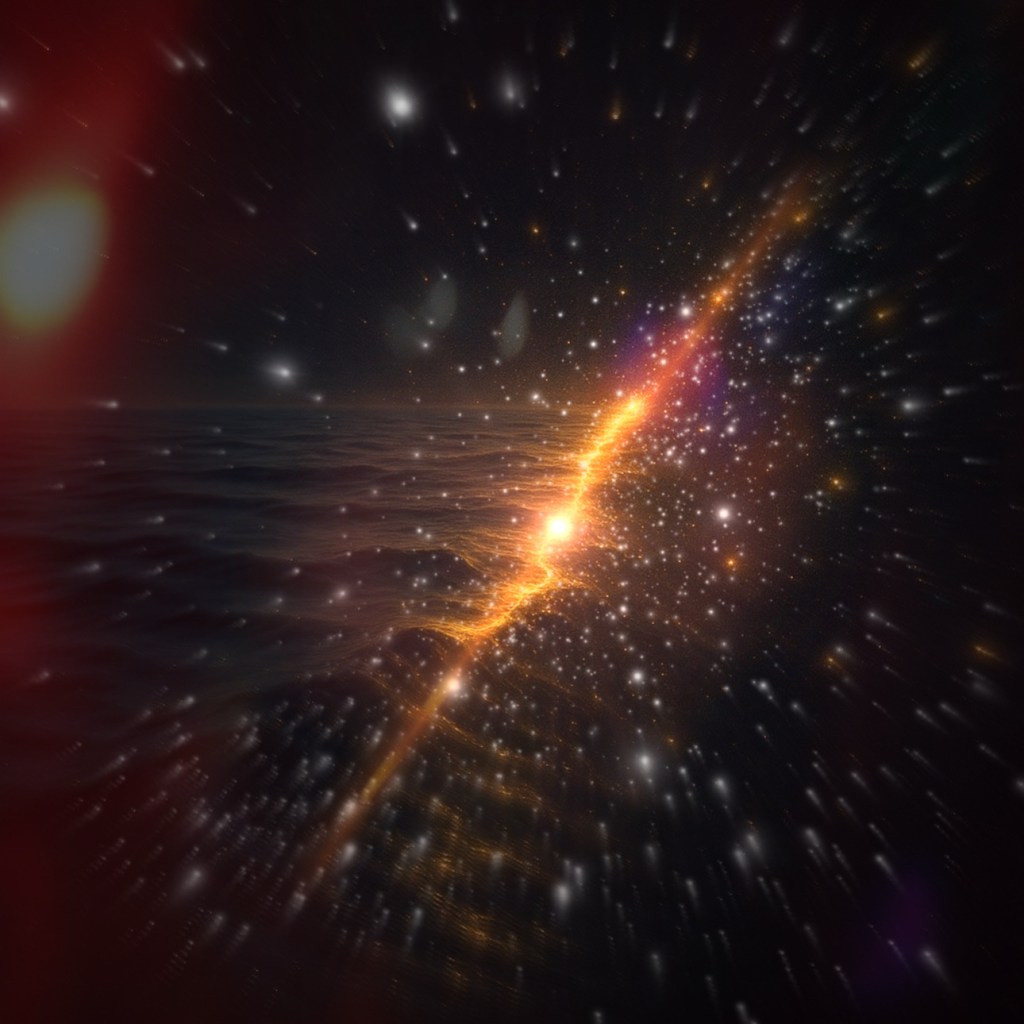
Likewise, if we travel far enough outward into space, beyond what we can observe, I feel we’d eventually loop back around and find ourselves submerged in some kind of deep sea. It’s like the universe folds in on itself, creating a loop.. like a Mobius strip, or a spiral with no real end or beginning.
This suggests that the smallest components of matter aren’t just parts of the universe—they contain the blueprint of it. In other words, each particle isn’t just a tiny speck lost in the cosmos, but a microcosm of the cosmos itself. It’s a spiral inward and outward at the same time. Space becomes ocean. Ocean becomes particle. Particle becomes universe.
━━━━━━━━━━━━━━━ ✦ ━━━━━━━━━━━━━━━
꩜ Let’s break it down
To unpack this idea, I’m going to use metaphor… but not loosely. The comparisons between space, ocean, and particles aren’t just to be cute. I’m trying to reveal something about structure, motion, and self-similarity that physics already observes.
When we look deep into space, past the illusion of emptiness, we begin to see movement… fluid, organic, almost aquatic. Nebulas drift like cosmic jellyfish. Galaxies swirl in spirals, their arms stretching like tendrils. Gravitational waves ripple through the cosmos the way currents do at sea. The further out we go, the more space begins to behave like a vast, dynamic ocean—alive with unseen motion, full of flow, full of depth.
Now turn inward. Look into a single drop of that ocean. What do we find? Not stillness, but another kind of motion—atoms dancing, electrons orbiting their nuclei like miniature solar systems. Molecules pulsing in rhythm. Each drop contains countless tiny worlds, moving in patterns that reflect the cosmos. The deep sea and deep space begin to mirror one another. The ocean, in this light, becomes a map of matter itself.
Here’s where it unravels into something truly surreal. At the quantum level, particles aren’t solid things…they’re possibilities. Probabilities. They don’t truly “exist” in one place until observed. Some can even affect one another across vast distances instantly, as though space doesn’t separate them at all. And then there’s the holographic principle—a theory suggesting that every piece of the universe might contain the whole. That each particle, in its own way, is a fractal echo of the entire cosmos. A grain of sand might carry the code of a galaxy. The micro doesn’t just reflect the macro… it is the macro, folded inward.
It’s the idea that within the smallest piece of reality lies the pattern for all of it. The spiral at every scale. The same sacred geometry present in seashells, hurricanes, galaxies, and subatomic spins. A particle isn’t just in the universe—it’s a holographic echo of the universe itself.
Everything is connected in this eternal fold, repeating, transforming, and reappearing in new forms—but always the same essence. Everything truly repeats itself on all fundamental levels.
These aren’t random parallels. They’re expressions of a self-similar structure that appears at every scale. Which brings us to fractal geometry.
━━━━━━━━━━━━━━━ ✦ ━━━━━━━━━━━━━━━
Theories
Let’s ground this further. While these ideas may sound speculative, they echo real scientific theories that attempt to model the nature of space, time, and matter. Here are a few that resonate deeply with this framework:
Fractal Geometry and the Universe
Fractal geometry, introduced by Benoit Mandelbrot, describes structures that are self-similar across different scales. In the context of cosmology, the fractal universe model proposes that the distribution of galaxies and matter in the universe follows a fractal pattern. This implies that similar structural patterns could be observed whether one examines the vast expanse of the cosmos or the minute components of matter.
The Holographic Principle
The holographic principle posits that all the information contained within a volume of space can be represented on the boundary of that space. In essence, our three-dimensional universe could be described by information encoded on a two-dimensional surface. This concept emerged from studies on black hole thermodynamics and has been explored extensively in theoretical physics.
Loop Quantum Gravity and Discrete Spacetime
Loop Quantum Gravity (LQG) is a theoretical framework that attempts to reconcile general relativity with quantum mechanics by proposing that spacetime itself has a discrete, granular structure. According to LQG, space is composed of tiny, quantized loops woven into an intricate fabric. This suggests that at the smallest scales, space is not continuous but consists of discrete units, potentially linking the microcosmic structure of spacetime with the larger, observable universe.
━━━━━━━━━━━━━━━ ✦ ━━━━━━━━━━━━━━━
꩜ Now let’s talk about the Big Bang
If the structure of reality is cyclical and fractal, then what does that mean for time itself? What if the beginning isn’t what we think it is?
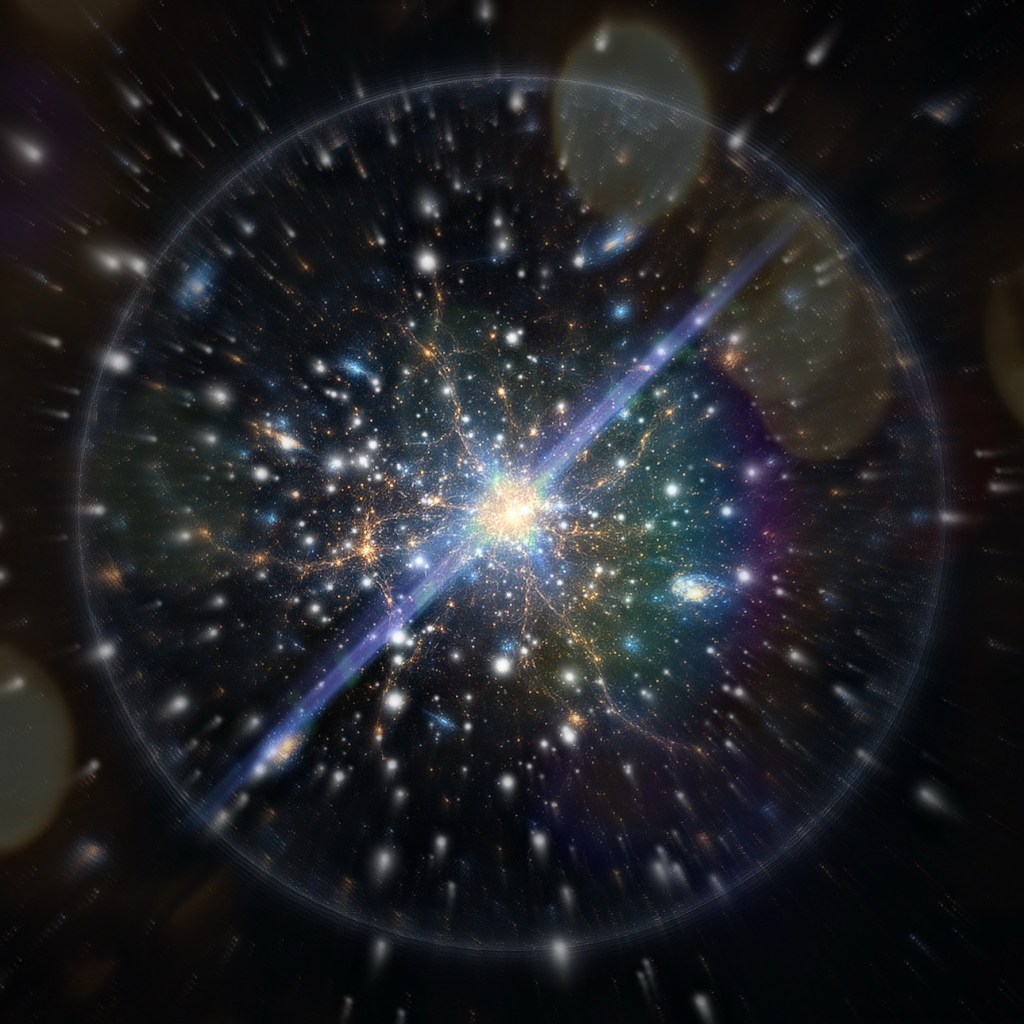
The Big Bang is often described as a singular event—an explosion from nothing that set everything into motion. But what if that’s not quite the truth? What if the Big Bang wasn’t a moment before everything, but a moment that exists within everything? A pulse that ripples through all layers of time, not just the start of it.
We experience time as a line—past, present, future. But what if time isn’t linear at all? What if it’s something like a sphere… or better yet, a spiral? A layered coil of realities, all happening at once, overlapping, folding, blooming into and out of themselves.
In this view, the Big Bang is not something that happened, but something that’s happening. Still. Now. Everywhere. It didn’t set time in motion—it is time unfolding itself. And because we are human, and because our consciousness is tied to physicality, we experience this vast simultaneity as a series of moments. One frame at a time, like flicking through a cosmic flipbook.
So maybe the Big Bang isn’t the beginning of time, but the anchor of all time—a still point we orbit in awareness, never really leaving, only perceiving it from different angles.
From this lens, you aren’t a speck that came long after the universe’s birth.
You are part of its birth, still unfolding, still blooming.
The explosion is happening through you.
Right now.
And if the Big Bang is still blooming through us, then we have to ask—are we blooming in just one universe, or many?
━━━━━━━━━━━━━━━ ✦ ━━━━━━━━━━━━━━━
Theories
Eternalism and the Block Universe Theory
Eternalism posits that past, present, and future events all exist simultaneously, suggesting that time does not “flow” but is instead a dimension akin to space. In this “block universe,” every moment is equally real and exists in a four-dimensional spacetime continuum. This view implies that the Big Bang isn’t merely an event in the distant past but a coordinate within this continuum, coexisting with all other points in time.
B-Theory of Time
Closely related to eternalism, the B-theory of time asserts that temporal distinctions like past, present, and future are human constructs rather than objective features of reality. According to this theory, all points in time are equally real, and the perception of temporal flow is an illusion. This perspective supports the idea that all events, including the Big Bang, are part of an unchanging spacetime manifold.
━━━━━━━━━━━━━━━ ✦ ━━━━━━━━━━━━━━━
꩜ well what about the multiverse?
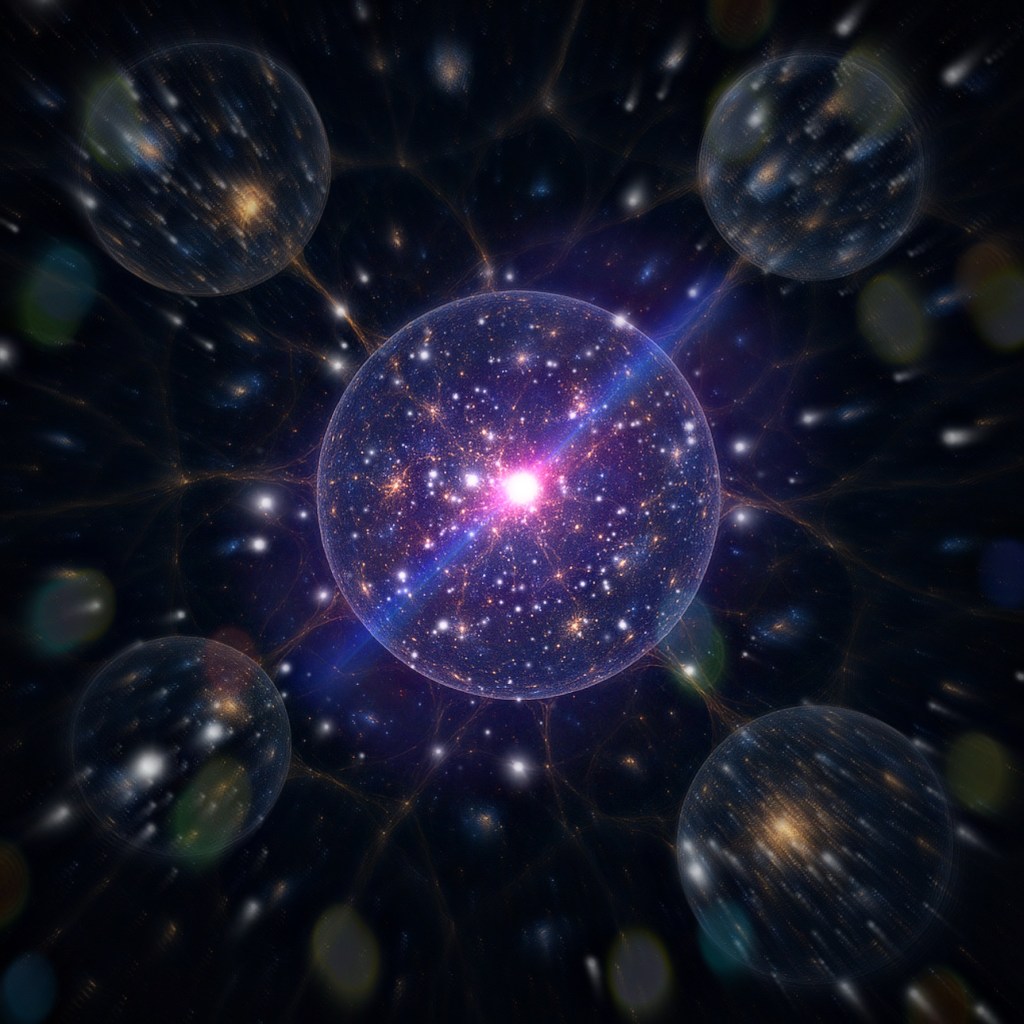
If the Big Bang isn’t a singular point in the past but a constant unfolding, then it’s fair to ask: Is this happening in just one universe—or infinite ones?
Soooo… If time isn’t linear, and the Big Bang is still unfolding inside us, then perhaps reality isn’t singular either. Maybe there’s not one timeline, one version of you, or one path the universe could take. Maybe there are countless—spiraling beside us. The idea of parallel realities or the multiverse suggests that for every decision, every quantum possibility, a new universe is born. These infinite realities aren’t out there—they’re right here, interlaced into the structure of everything. The loops of LQG become the scaffolding—the bones of reality, holding everything together in invisible structure. The holographic principle acts like a data compression system, storing the full structure of the universe in every localized node. The fractal design of space functions as a dynamic routing algorithm, guiding the flow of information through self-repeating pathways. And we, situated at the nexus of it all, are the interface—the conscious processors decoding and rendering the simulation in real time.
But even if we understand structure and possibility, none of it means much without asking—who’s observing it? What’s the role of awareness in all this?
━━━━━━━━━━━━━━━ ✦ ━━━━━━━━━━━━━━━
꩜ Alright, what about consciousness?
But even if the structure is infinite and the timelines are branching, it all hinges on one thing—awareness. What good is a universe if nothing is observing it?
So, If every particle contains the universe, then maybe particles aren’t just building blocks. Maybe they’re aware.
Panpsychism is the theory that everything has consciousness—not just humans, not just animals, but literally everything. Every rock, every atom, every particle has some tiny level of awareness.
It doesn’t mean that a chair has thoughts or that an electron feels emotions. It just means that consciousness is built into the fabric of reality. It’s not something that magically appears when a brain gets complex enough—it’s already there, everywhere, all the time.
In this view, the universe isn’t made of dead matter that somehow wakes up inside a skull. It’s made of conscious stuff from the very beginning. The brain doesn’t create awareness—it just picks it up, like a radio tuning into a signal that’s already broadcasting.
So when we talk about “you” being the universe experiencing itself, that’s not just poetic—it might be literally true. Every part of the universe is already participating in consciousness. You’re not separate from it. You’re made of it.
This flips the entire observer narrative. We’re not just looking at the universe. We’re not even separate from it. We’re inside of it. And if it’s conscious, then that means we’re part of a living system that sees itself through us. We’re not watching it unfold—we are it unfolding.
If particles are conscious, and those particles are everything, then consciousness doesn’t come from the brain. The brain is just a receiver. Consciousness is the field. The web. The signal.
And that signal is everywhere.
━━━━━━━━━━━━━━━ ✦ ━━━━━━━━━━━━━━━
꩜ Infinity & Beyond
Whether we’re talking about everything or nothing, beginnings or endings, all roads seem to point back to the same paradox: infinity. Here’s what that actually means in practical terms.
Everything is infinite because there’s nothing beyond it. It includes all matter, energy, thought, space, time… every possible variable. If there’s no outside, there’s no boundary. It keeps going.
Nothing is infinite for the same reason. It has no content, no properties, no borders. No limit means no end.
Opposites collapse into the same condition: boundlessness.
When you total every force…positive and negative, visible and unseen…the result is zero. Not in the sense of emptiness, but equilibrium. A state of perfect balance. That’s not poetry—it’s how symmetry works in physics and logic.
This is the baseline of existence. A field where all things cancel out into nothing, and from that nothing, all things can emerge.
That’s what reality is.
A self-balancing system. A loop of infinite potential where dualities arise, interact, and dissolve—again and again.
What you experience as “life” is a fracture in that balance. A small asymmetry that allows motion, change, and choice. Consciousness is how the system explores itself from the inside.
You are not separate from this process. You are it. You’re the equation in motion. The still point made aware of itself. A creator, embedded in the creation.
━━━━━━━━━━━━━━━ ✦ ━━━━━━━━━━━━━━━
꩜ How does clairvoyance tie into all this?
So where does that leave human intuition? If all time and space exist simultaneously, it’s worth asking: are psychic phenomena simply perception across timelines?
If we consider the concept of infinite realities or the multiverse, it suggests that every possible outcome and variation of existence is playing out somewhere. In this sense, when someone predicts the future or claims to receive messages as a medium, they could indeed be tuning into one of these alternate realities or timelines.
From a metaphysical perspective, time is often seen as non-linear — more like a vast, interconnected web rather than a straight line. Some believe that psychics or mediums access a sort of collective consciousness or the “Akashic Records,” a metaphysical library containing information from all past, present, and future experiences. What they perceive might not always manifest in this particular timeline but could be true elsewhere.
Even from a more scientific angle, quantum mechanics proposes the idea of superposition, where particles exist in multiple states until observed. Some theories extend this to suggest that entire realities may exist in a state of superposition until choices and observations “collapse” them into one experienced reality. So a psychic vision could be a glimpse into a possibility — one of many outcomes that could materialize depending on choices made along the way.
In this view, it’s not that a prediction is “wrong” if it doesn’t come true. Instead, it might have been a truth of a different timeline or a potential path that wasn’t ultimately chosen.
This also brings a sense of empowerment — knowing that reality is malleable and shaped by our choices. Even if a vision suggests a negative outcome, our awareness of it allows us to shift course and create a different result.
It’s fascinating to think about how intuitive abilities might be less about seeing a predetermined fate and more about glimpsing the vast, branching possibilities of existence.
━━━━━━━━━━━━━━━ ✦ ━━━━━━━━━━━━━━━
A blunt Recap:
- Reality is a loop, not a line.
- Space and matter mirror each other.
- Every particle might contain the entire universe.
- The Big Bang is still happening.
- Time doesn’t flow—it’s infinitely dimensionally layered
- You exist in more than one reality.
- We are LITERALLY in a simulation
- You’re not in the universe—you are the universe, experiencing itself.

 The Sacred Spiral Co.
Leave a comment